

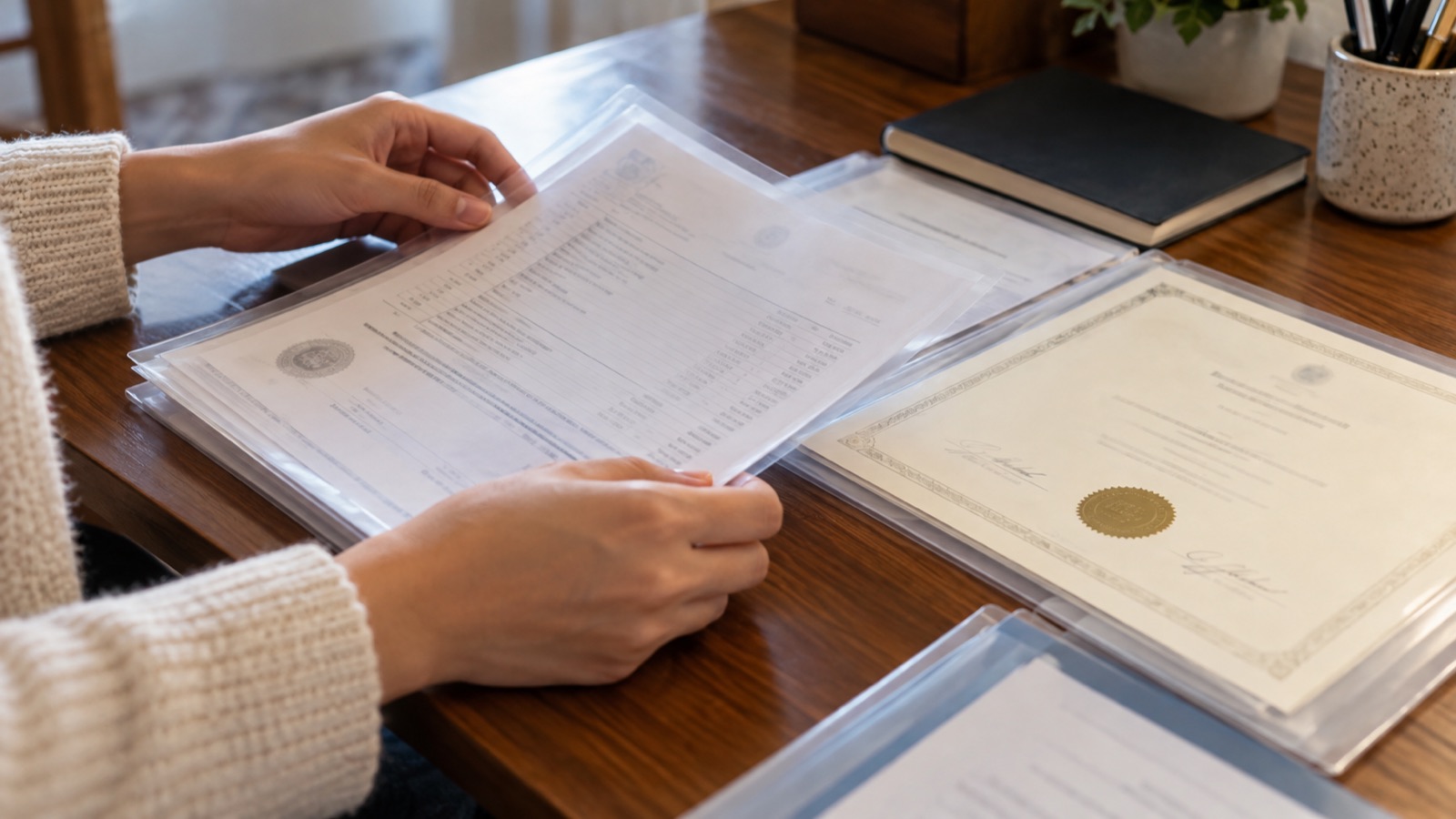
Chinese credentials: what institutions assess
Before looking for an “equivalency,” identify the level you want to pursue in Canada and the curriculum you followed. The examples below concern the mainland China education system; if you followed the IB, A-levels or another curriculum, consult the requirements for your credential.
| Plan | Example of published requirements | Point to consider |
|---|---|---|
| Undergraduate studies at McGill University | Upper secondary transcripts, Huikao or Academic Proficiency Test results already obtained, and Gaokao results if taken | When the Huikao is reported as pass or fail, or is not offered, McGill normally expects additional academic results. Other information may be submitted and, if no other information is submitted, the application may be assessed on a case-by-case basis. |
| Undergraduate studies at Université Laval | A terminal diploma representing 12 years of pre-university education and 1 successful year of postsecondary studies | Preparatory studies may be considered in some cases for non-restricted programs. |
| Master’s at UBC Vancouver | Generally, a bachelor’s degree of at least 4 years and an overall average of B+ | The China profile provides for a special consideration for certain universities in the 211 Project; the program may add its own requirements. |
These examples compare institutional requirements: they do not rank universities or prejudge a decision. For each program, also check prerequisite subjects and other admission criteria.
Transcripts and translations: plan for 2 recipients
The university and Immigration, Refugees and Citizenship Canada (IRCC) do not assess the same application documents. For each document, note who issued it, the required language, how it must be submitted and the deadline. If your final results are not yet available, ask the institution which interim documents it accepts.
For undergraduate studies at McGill University, a translation of transcripts that are not in French or English may be provided by the issuing institution or by a certified translator. This example does not address all other documents: consult the instructions of the institution concerned.
IRCC applies its own rules. Its guide provides, among other things, that a translator’s affidavit may be required; the person applying and their family members must not translate documents intended for the federal application themselves. Therefore, compare both sets of instructions before ordering a translation.
French or English: which proof should you prepare?
The right test is the one that meets the requirements of your chosen program. First, check which forms of proof are accepted, whether exemptions apply, how long results are valid and the minimum scores for each component.
For undergraduate studies at UBC Vancouver, IELTS Academic is one option: the university specifies a minimum overall score of 6.5 and 6.0 in each component. It also accepts other ways of demonstrating English proficiency. For a master’s program, check the applicable requirements separately; this score is not a federal standard.
At Université Laval, some applicants with a non-French-language educational background may be asked to take the TCF. The requirements depend on the application and program. Do not assume, therefore, that a test requirement or exemption applies to everyone who has studied in China.
Study permits: the local checklist and attestation letters
When a study permit is required, the letter of acceptance from a designated learning institution and IRCC’s decision are 2 distinct steps. Consult both the general instructions and the instructions generated for your application.
IRCC’s “China” selection refers, among other things, to IMM 5977 E, the additional checklist for the Beijing, Guangzhou and Shanghai visa offices. The February 2026 version mentions, among other items:
- form IMM 0104 for the applicant and their parents;
- identification and the original hukou, or household register;
- academic documents, a study plan and financial evidence.
The checklist also provides for police certificates for people over 18, depending on the countries where they have lived for at least 6 consecutive months since turning 18. Check whether this checklist and its current version apply to your application. For an online application, follow the submission instructions provided to you.
A provincial attestation letter or territorial attestation letter (PAL or TAL) is generally required, subject to exceptions. Since January 1, 2026, an exemption applies, among other cases, to master’s and doctoral programs leading to a degree at a public designated learning institution; it does not automatically cover all graduate programs.
In Quebec, the attestation of issuance of a Quebec Acceptance Certificate, or CAQ, serves as a PAL in applicable cases. Most people exempt from a PAL or TAL must nevertheless obtain a CAQ, subject to exceptions. The CAQ does not replace the federal study permit.
Proof of funds: understand the amount and what it covers
The amount you must demonstrate depends, among other things, on your destination, the date of application and the number of people concerned. Here are the published annual amounts for 1 person:
| Destination | Amount | Applicable date |
|---|---|---|
| Outside Quebec | $23,448 CAD for living expenses | Applications submitted on or after September 1, 2026 |
| Quebec | $24,617 CAD for basic needs | Applications submitted on or after January 1, 2026 |
These amounts are not a complete budget. Tuition and round-trip transportation are separate. The categories are not identical: in Quebec, basic needs include, among other things, settlement and health insurance. Family-size thresholds also differ.
IRCC requires you to demonstrate that you have the necessary funds without relying on work in Canada. For a program of more than 1 year, you must demonstrate funds for the first year and explain how you will pay for the rest.
The local checklist IMM 5977, for its part, requests proof of accumulation of funds showing a history of at least 12 months. This is not a general requirement to lock away a sum of money for 12 months. Instead, consider which supporting documents can explain the origin and availability of the funds, according to the applicable instructions.
Biometrics, medical exams and processing times
If IRCC asks for your fingerprints and photograph, follow the instruction letter. Biometrics provided for a temporary residence application are generally valid for 10 years; exemptions exist.
The fees displayed when consulted were $150 CAD for a study permit and $85 CAD for individual biometrics, when required. Check the fees when you pay and budget separately for any other potential expenses, such as translations, tests and travel.
A medical exam may also be required. For a planned stay in Canada of more than 6 months, IRCC requires one, among other circumstances, when a person has lived in or travelled to 1 or more countries on its list for at least 6 consecutive months during the year before arrival. China is on this list. Other criteria and some exemptions may apply; when an exam is required, it must be completed by a panel physician.
For your timeline, separate university deadlines from the time needed to collect documents, obtain attestations and have the permit application processed. IRCC’s tool provides an estimate, not a guarantee of a decision by a specific date. Select the relevant category and location: no fixed processing time in weeks is stated here.
Finally, be wary of outdated advice about an accelerated process: the Student Direct Stream closed on November 8, 2024.
Scholarships connected to China: distinguish between degrees and research
Funding may be intended for a specific level of study or type of stay. Two options illustrate this difference:
- The partnership between McGill University and the China Scholarship Council concerns doctoral studies and provides for support of up to 4 years. McGill sets out citizenship or residency, admission and selection requirements; successful candidates must return to China after their studies or research. Check the relevant competition without assuming that a new application period is open.
- The Canada-China Scholars’ Exchange Program is aimed instead at certain researchers and qualified professionals undertaking research stays, rather than enrolling in a degree. The call listed a deadline of June 30, 2026, at 2 p.m. Beijing time: it was closed as of the consultation date. Do not assume a later competition is open.
For each funding opportunity, check the eligibility criteria, covered expenses and application process. In your financial plan, distinguish a potential funding source from a scholarship that has actually been awarded.
Universities and programs: build your comparison
These StudyCanada profiles are starting points for exploring the institutions mentioned in this guide:
- McGill University: an example to help you review secondary school transcripts, the Huikao and the Gaokao.
- Université Laval: an option for comparing undergraduate admission and French-language requirements.
- The University of British Columbia: separate guidance on master’s studies and proof of English proficiency for undergraduate studies at Vancouver.
The profiles do not establish that a program is available or that you are eligible. To compare your options, prepare 1 row for each program: required credential, prerequisites, language, documents, deadline, published fees and confirmed funding. Then compare these requirements with the date your results and documents will be available. Admission, the award of a scholarship and the issuance of a study permit remain separate decisions.