

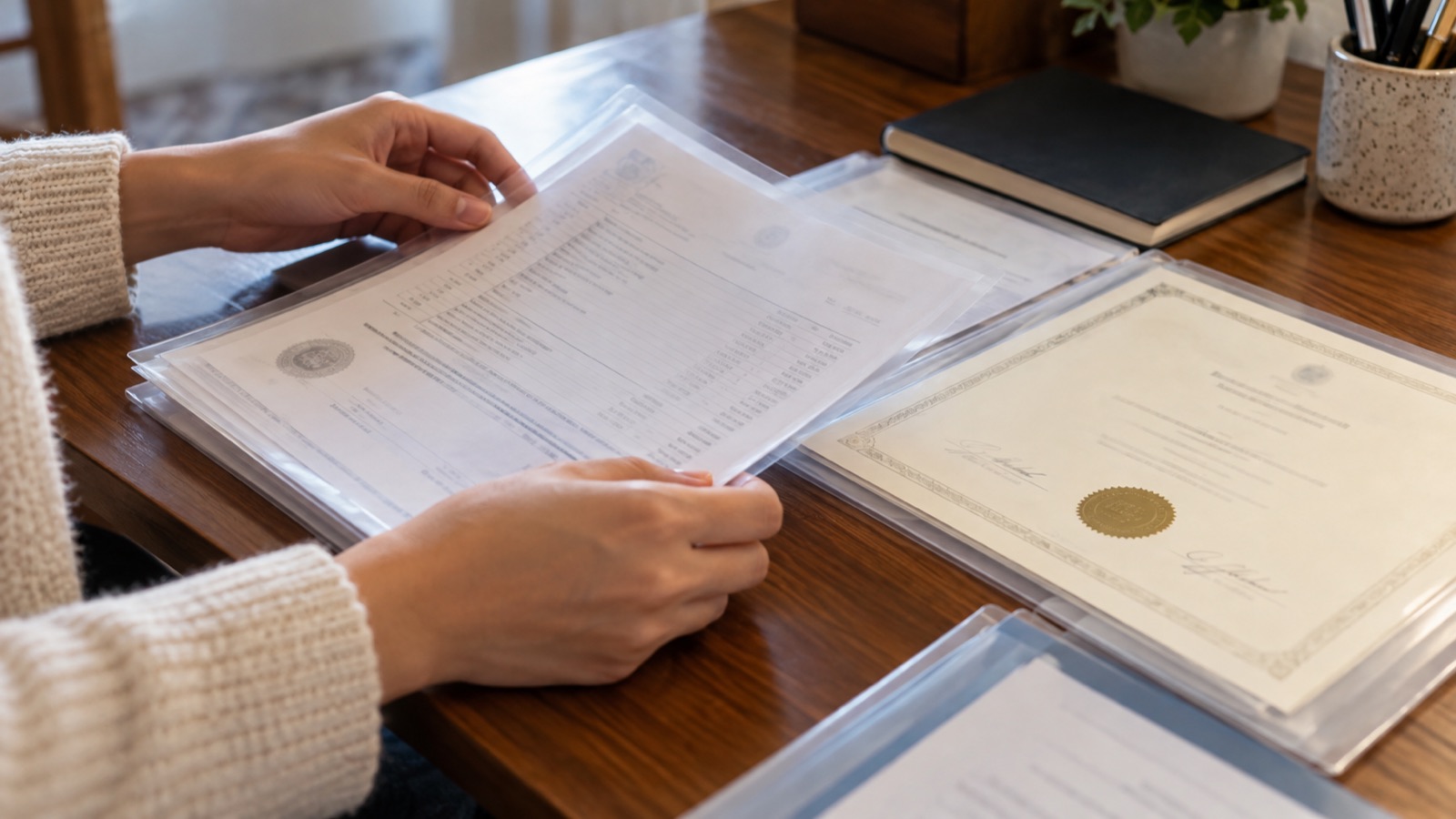
From a Colombian credential to a Canadian application
The Título de Bachiller is a credential awarded at the end of secondary school. Despite the similarity between the words, it should not be confused with a Canadian bachelor’s degree. Saber 11, the assessment administered by ICFES, is separate from the credential; it should not be assumed to be mandatory for every Canadian application.
The right question is therefore not just “What is my credential equivalent to?” but rather: “Does my academic background meet the requirements of the program I’m interested in?” The number of years of study, the subjects taken and your results may all be considered when your application is assessed.
If you have already started postsecondary studies in Colombia, keep your transcripts and other records from those studies as well. Do not assume that a university will assess your application in the same way as that of someone applying directly from secondary school.
Universities and programs: comparing two admission pathways
The official pages from Ottawa and Laval illustrate two ways of presenting undergraduate admission requirements for applicants with a Colombian academic background. The links below lead to the institutions’ StudyCanada profiles; the requirements in the table come from the universities themselves.
| Institution | Published pathway for a Colombian academic background | Question to ask yourself |
|---|---|---|
| University of Ottawa / Université d’Ottawa | The university assesses applications based on the Título de Bachiller. | Do my grades and subjects meet the program requirements? |
| Université Laval | The standard pathway listed includes a terminal pre-university credential, 11 years of pre-university studies and two years of successfully completed postsecondary studies. | Do I need to complete additional studies before applying? |
At Université Laval, one successfully completed year of postsecondary studies may also make it possible to take preparatory courses before entering a non-quota program. This is not automatic admission. At the University of Ottawa, requirements and documents also vary depending on whether you have undertaken postsecondary studies.
This comparison is neither a ranking nor a national equivalency chart. For each program you are considering, check the prerequisites, language requirements, documents and deadlines. Meeting the minimum requirements does not guarantee a place.
Transcripts, the Bogotá checklist and translations: preparing two applications
Separate the documents intended for admission from those intended for a possible study permit application. The same transcript may be useful for both processes, but their instructions are not necessarily the same.
For an application based on Colombian secondary studies, the University of Ottawa asks for transcripts from the last 3 years and, depending on where you are in your studies, a transcript for the current semester or proof that you have earned your credential. Any postsecondary studies you have already undertaken must also be documented. These instructions are specific to the University of Ottawa: check the requirements of each institution you are considering.
For a study permit, consult the general guide from Immigration, Refugees and Citizenship Canada (IRCC) as well as the instructions that apply to your application. The Bogotá visa office’s additional checklist, IMM 5821, should be read together with the general checklist; the version consulted is dated February 2026.
A document in Spanish submitted to IRCC must be accompanied by a translation into English or French. The federal guide requires a compliant affidavit when the translator is not certified in Canada; the applicant and their family members cannot do the translation. The Bogotá checklist also mentions a certified translation. Before ordering a translation, compare the applicable federal and local instructions, then check the university’s requirements separately.
French or English: choosing the right proof
Before booking a test, check the language of instruction, accepted test versions, required results and possible exemptions. A test used for an immigration process is not necessarily accepted for university admission.
For undergraduate admission at the University of Ottawa, an IELTS Academic score of 6.5 overall and in writing meets the requirements for admission without language conditions. The university also describes a pathway at 6.0 that includes additional English courses. These guidelines are specific to the University of Ottawa and do not guarantee admission to the program.
For French, the University of Ottawa indicates that it does not recognize the TCF Canada and TEF Canada versions for undergraduate admission. Université Laval identifies the TCF as its reference test and may accept certain DELF or TEF results subject to conditions: these results must, among other things, be less than 2 years old and include a written expression component.
Check the requirements that apply to your application before paying for an exam: the test, its components and the required level may depend on the program.
After admission: attestation letters and study permits
When your plans require a study permit, the application generally includes a letter of acceptance from a designated learning institution, proof of identity and proof of financial support. A provincial or territorial attestation letter, called a PAL or TAL, is also generally required, subject to exceptions. Admission by the institution and the federal decision on the permit are separate.
Since January 1, 2026, applications for a degree-granting master’s or doctoral program at a public designated learning institution are among those exempt from the PAL or TAL requirement. This exemption does not automatically extend to all graduate certificates.
In Quebec, also check the requirements for a Québec Acceptance Certificate (CAQ). When required, its attestation of issuance bearing the wording required by IRCC serves as a PAL. Most people who are exempt from a PAL or TAL still need to obtain a CAQ, subject to applicable exceptions. The CAQ does not replace the federal study permit.
Documents and exemptions depend on your circumstances: consult the official instructions that apply to your plans rather than inferring your obligations based only on your destination.
Proof of funds: budget for more than tuition
For studies lasting at least 1 year, IRCC requires you to demonstrate that you have the resources needed for your first year. If your program is longer, you must also explain how you will pay for the entire duration of your studies, without relying on working in Canada.
Outside Quebec, the living-expense amounts applicable to applications submitted on or after September 1, 2026 include the following. This is an excerpt: consult the full table for a larger family.
| Applicant and accompanying family members | Annual living expenses outside Quebec |
|---|---|
| 1 person | 23,448 CAD |
| 2 people | 29,192 CAD |
| 3 people | 35,888 CAD |
These amounts do not include tuition or transportation. In Quebec, the amounts listed for 2026 include 24,617 CAD in essential needs for 1 person and 34,814 CAD for 2 people; tuition and round-trip transportation must be considered separately.
The two schedules do not cover exactly the same expenses. Quebec’s essential needs include, among other things, settling-in costs and insurance: the figures are therefore not a direct comparison of the cost of living. An administrative threshold is not a personalized budget either.
To prepare your plan, separate living expenses, tuition and transportation, then match available resources with supporting documents. A scholarship that covers tuition alone does not, by itself, demonstrate that all other expenses are funded. Check the amounts in force when you submit your application.
Biometrics, fees and processing times: organize two timelines
If IRCC asks you for fingerprints and a photograph, follow the instructions and deadline in the biometrics instruction letter you receive. IRCC lists collection centres in Bogotá, Cali and Medellín; their presence in the directory does not guarantee that an appointment will be available.
At the time of consultation, the posted federal fees were 150 CAD for a study permit and 85 CAD for individual biometrics, when required and subject to a fee. Other fees may apply.
To check study permit processing times, use IRCC’s current tool and select the relevant category and country. The time shown is a variable estimate, not a guarantee of a decision before the start of the academic term. No fixed number of weeks is provided here for Colombia.
Instead, build two timelines:
- Application: obtaining transcripts, proof of language proficiency, translations and the institution’s deadline.
- Authorizations: applicable provincial documents, proof of funds, submitting the federal application and biometrics if requested.
The time needed to prepare the first application should not be confused with the federal processing-time estimate for the second.
A scholarship option for a short-term exchange
The Emerging Leaders in the Americas Program supports short-term mobility in Canada. Colombia is among the countries whose citizens may be eligible: residing in Colombia is not enough to establish eligibility. The program is not a general scholarship intended to fund an entire degree.
For the 2026-2027 cycle, applicants were required, among other things, to be enrolled full-time at a postsecondary institution located in an eligible country or territory and to pay tuition to their home institution. Other conditions apply.
Canadian institutions select eligible participants and submit applications: direct individual applications are not accepted. At the time of consultation, the call for applications for Canadian institutions was closed. If you are interested in an exchange, ask your home institution and the institutions involved about the opportunities and deadlines for the relevant cycle.
To choose your next step, summarize each option on a sheet: required credential and studies, prerequisites, language, documents, deadline and funding. Then compare this sheet with your Colombian academic background and the timeline for authorizations. Admission, a scholarship and a study permit are 3 separate decisions: none guarantees the others.