

Understanding your Brazilian credential
There is no automatic equivalency that grants access to all Canadian universities. The name of the credential, length of study, grades and prerequisite subjects must be assessed according to the programme you choose.
| Your education | Example of a published requirement | What to keep in mind |
|---|---|---|
| Completion of Ensino Médio | For undergraduate studies, the University of Ottawa assesses, among other things, the Diploma/Certificado de Ensino Médio, with a minimum average of 7.0 and the programme prerequisites. | The threshold may be higher depending on the programme; meeting the minimum does not guarantee admission. |
| Applying for undergraduate studies at Université Laval | Université Laval normally requires 12 years of schooling and 1 year of postsecondary studies. | Preparatory schooling may be considered if the requirements are not met, for programmes that are not subject to enrolment limits. |
| Applying for a master’s degree after a university credential | Ottawa’s table mentions, among other credentials, the 4-year Bacharelado/Bacharel and a minimum average of 7/10. | Other credentials are listed in the table, and the programme may have its own additional requirements. |
These examples are for comparing requirements, not ranking institutions. For a technologist credential or a specialization, ask the university to assess your education rather than assigning it an equivalency yourself.
Prepare two application files and translations
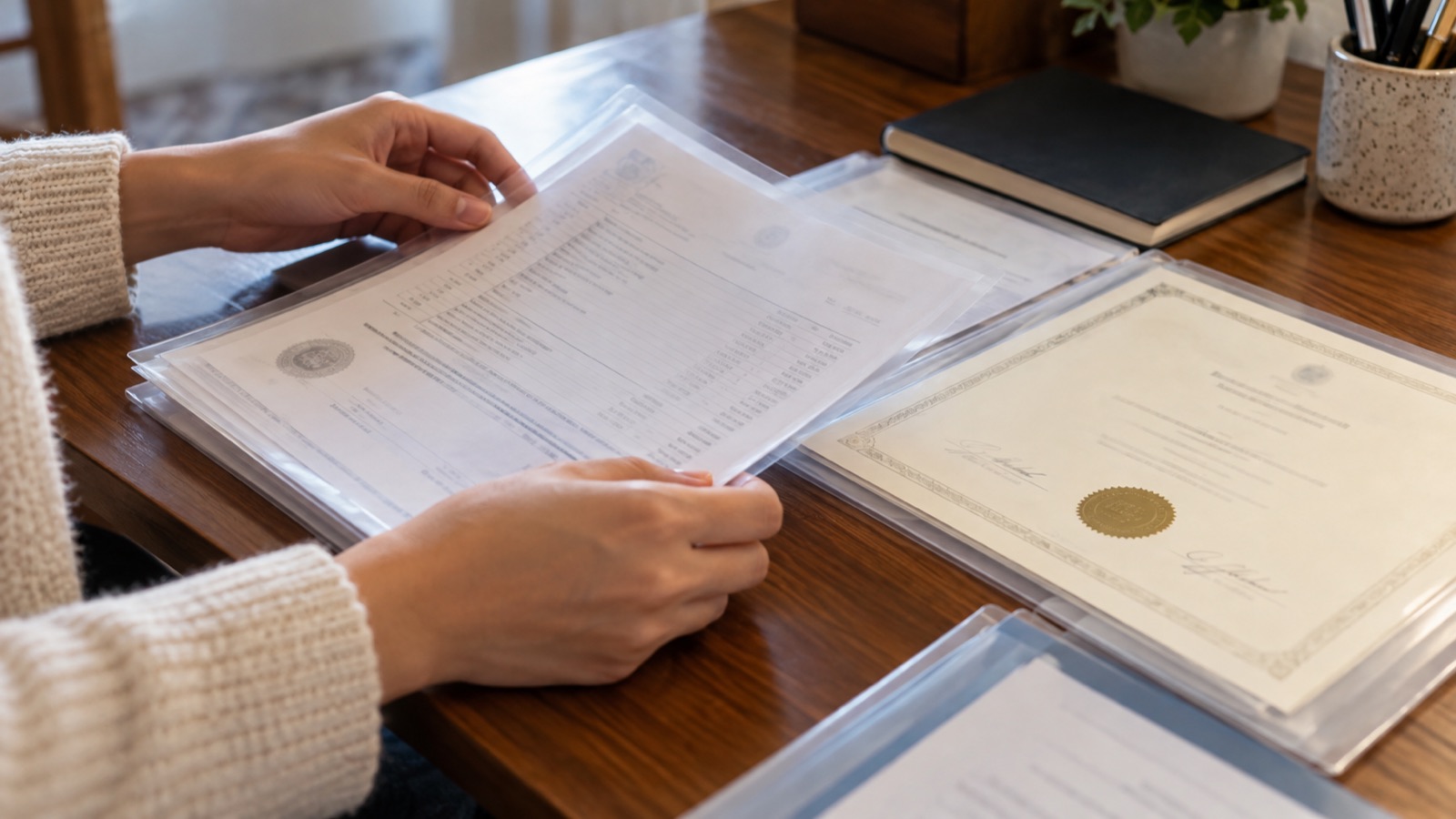
Gather your diplomas and transcripts from secondary school and, if applicable, postsecondary studies. For each application, ask the institution which years of study to document, what format to use and what provisional documents it accepts if you have not completed your studies.
If a university asks for your Enem results, Inep allows you to view individual results on the Página do Participante. This does not mean that all Canadian universities require or accept them.
Next, keep a separate checklist for your study permit application. Immigration, Refugees and Citizenship Canada (IRCC) requires a document that is not in English or French to be accompanied by a translation. If the translator is not certified in Canada, a compliant affidavit is required. The applicant and their family members cannot translate the documents themselves.
Before ordering a translation, compare IRCC’s instructions with the university’s: a document prepared for admission may not meet all the requirements of the immigration application.
Choose proof of language proficiency
First, choose the programmes you are interested in. Then check which version of the test is accepted, the overall score, scores for each skill, possible exemptions and when results must be submitted.
For direct entry to undergraduate studies without a language condition, Ottawa, for example, indicates 6.5 on IELTS Academic, both overall and in writing. This is a requirement for this admission route, not a threshold that applies throughout Canada.
At Université Laval, the French proficiency page presents the TCF tout public for people who did not complete their primary or secondary education in French. It indicates that the test is taken after the admission application is submitted; a test taken earlier may be considered if it was taken no more than 2 years before the application. The consequences of the result depend, among other things, on the programme. Before booking an exam, therefore, check the order of steps with each institution.
Admission, attestations and permits: who requests what?
A study permit application includes, among other things, a letter of acceptance from a designated learning institution, proof of identity and financial documents. Other documents may be required depending on your situation.
A provincial attestation letter or territorial attestation letter, or PAL/TAL, is generally required, with some exceptions. These include, among others, certain master’s or doctoral programmes at a designated public institution. Check the specific requirements and the proof requested if you think you are exempt.
In Quebec, for a programme lasting more than 6 months, a Québec Acceptance Certificate (CAQ) and a study permit are normally required, subject to exemptions. IRCC normally asks for the CAQ issuance attestation rather than a separate PAL/TAL: check its validity and the required wording. A federal PAL/TAL exemption does not automatically remove Quebec’s CAQ requirement, and the CAQ does not replace the federal permit.
Consult IRCC’s personalized document checklist and the applicable local instructions. The São Paulo visa office’s additional checklist IMM 5849 F mentions, among other things, a study plan and financial documents. Check whether it applies to your location and method of applying rather than automatically applying it to all applications prepared in Brazil.
Build your proof of funds and budget
The administrative minimum is not the total cost of the plan. The following figures apply to 1 person for 1 year:
| Authority and application | Published amount | Separate expenses |
|---|---|---|
| IRCC — study permit outside Quebec, application submitted on or after September 1, 2026 | 23,448 CAD for living expenses | Tuition and transportation |
| Quebec — temporary selection for studies, application submitted on or after January 1, 2026 | 24,617 CAD for essential needs | Tuition and round-trip transportation |
The categories do not cover exactly the same expenses: the Quebec amount includes, among other things, establishment costs and health and hospitalization insurance. Amounts also vary according to the number of people concerned. For a plan in Quebec, also check the federal requirements that apply to the permit application.
IRCC requires you to demonstrate that you have the necessary funds without relying on employment in Canada. For studies lasting more than 1 year, you must also explain how you will finance the rest. The general financial page lists 6 months of bank statements among examples of supporting documents; the São Paulo checklist, however, mentions 3 months. Check the applicable instructions together, without assuming that 3 months automatically replaces the federal example.
For your own budget, separate tuition, living expenses, transportation and preparation costs. Match each source of funds with proof that it is available and, if needed, where it came from. Also allow for a margin for currency exchange and actual expenses.
Biometrics, fees and timelines
If IRCC asks for your fingerprints and photograph, wait for the instruction letter and follow the directions sent to you. IRCC indicates 30 days from the date of the letter to provide biometrics. This deadline is for collection, not for a decision on the permit; exemptions exist.
The federal directory lists centres in Brasília, Porto Alegre, Recife, Rio de Janeiro and São Paulo. Check the services and appointments before travelling.
In the fee schedule consulted, federal fees were 150 CAD for the study permit and 85 CAD for individual biometrics, when required and subject to a fee. They do not include any translation, travel or provincial application costs.
For study permit processing, consult IRCC’s tool and select the relevant category and country. The result is an estimate, not a guarantee. In your timeline, separate application and scholarship deadlines, obtaining documents, attestations, submitting the permit application and biometrics. If time is running short, ask the institution about its options for deferral.
Look for funding linked to Brazil
The following 2 programmes support different types of plans. Their dates relate to specific cycles: they do not allow you to assume that a call will be renewed.
The Emerging Leaders in the Americas Program, or ELAP, supports short-term study or research exchanges and includes Brazil among the eligible countries. Under the call consulted, applicants had to be enrolled full-time at an eligible postsecondary institution, among other requirements; Canadian institutions submitted the applications. Their deadline was March 31, 2026. This programme should not automatically be treated as funding for a full degree.
Quebec’s Programme de bourses d’excellence pour étudiantes étrangères et étudiants étrangers 2027-2028 includes Quebec–Brazil streams for doctoral research, postdoctoral research and short research or professional development stays. The deadline for universities and the Réseau des CCTT to submit preselected candidates to the Fonds de recherche du Québec was October 27, 2026. Those already preselected have until December 2, 2026 at 4 p.m. Eastern Time to submit their application to the Fonds. This second date does not open a new preselection round to everyone; other requirements apply.
To explore opportunities, also ask the international relations office at your Brazilian institution about partnerships and announced calls. In your financial plan, distinguish between funding you are considering and a scholarship that has actually been awarded.
Universities and programmes: compare your options
Two StudyCanada profiles can serve as starting points:
- University of Ottawa: its official information distinguishes, among other things, undergraduate requirements for Ensino Médio and master’s-level reference points for some Brazilian credentials.
- Université Laval: its page for people educated in Brazil outlines schooling requirements and the possibility of preparatory studies in the cases covered.
These profiles present institutions; they do not confirm that a programme is currently open or that you are eligible. For each option, note the credential required, prerequisites, language, documents, deadline and published fees. Then confirm the requirements with the institution.
A useful order for making decisions is: Brazilian education → programme requirements → documented budget → applicable authorizations. This will help you compare concrete options without relying on automatic equivalency or a guaranteed permit processing time.