

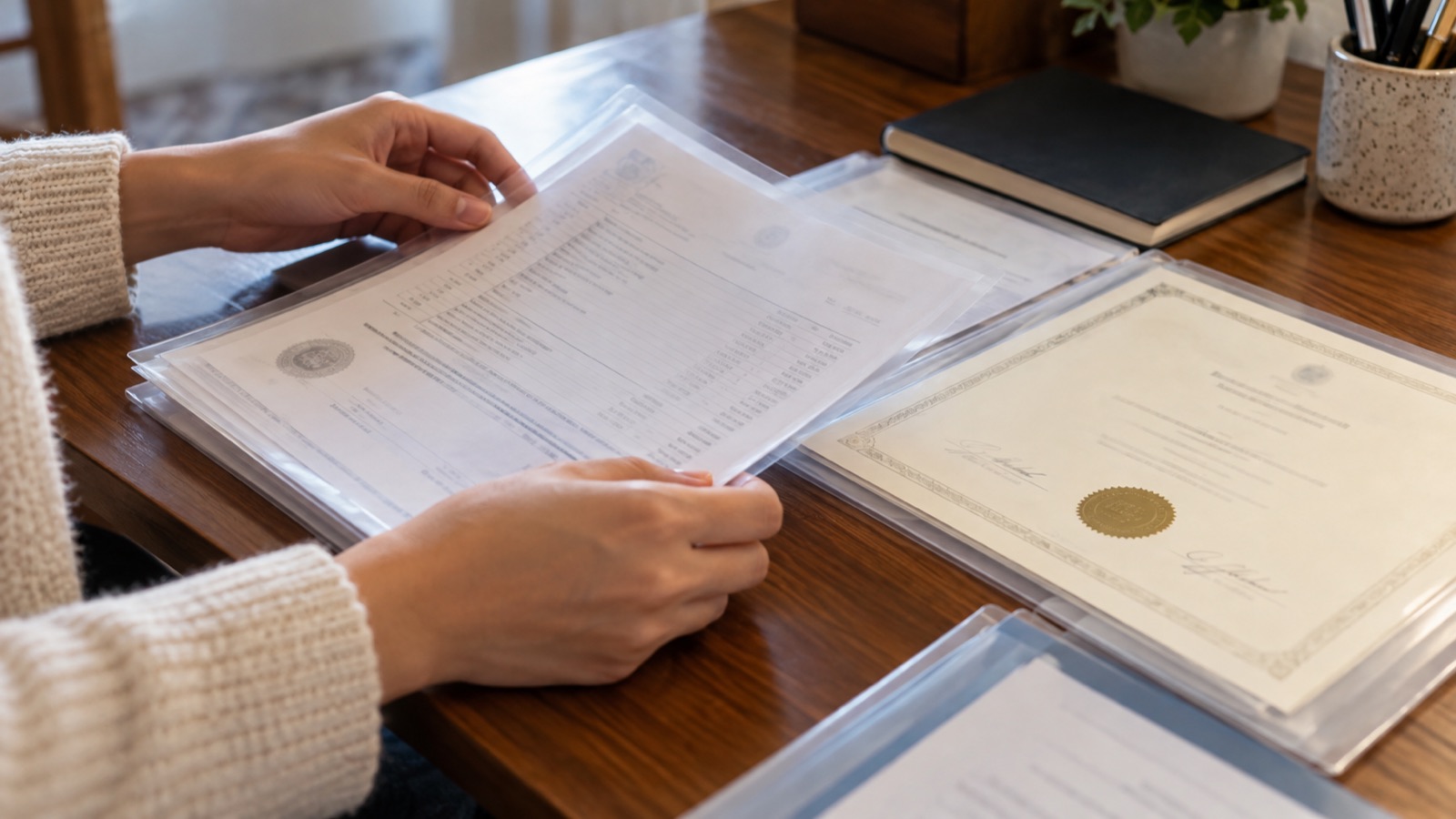
How is a Turkish diploma assessed?
Start by noting the exact name of your diploma, the subjects you studied and the grades you received. The answer then depends on the level and program you are considering: universities publish their own admission criteria.
For undergraduate studies, the University of Ottawa lists the Lise Diplomasi among the qualifications it assesses. McGill distinguishes between the Devlet Lise Diplomasi from public institutions and the Lise Bitirme Diplomasi from private institutions. McGill also assesses transcripts and prerequisite subjects.
These credentials are reference points specific to each institution, not a national equivalency framework or a guarantee of admission. If you completed an international or technical program in Türkiye, ask the university how it assesses that background. For a master’s or doctoral program, consult the requirements for the program you are considering rather than assuming that your diploma’s name alone establishes an equivalency.
Documents: prepare an admission application and a study permit application
The same document may be useful for both processes, but the requirements for how it is submitted or translated are not necessarily the same. Ask each university which diplomas and transcripts to provide, in what format and by what date. If your final diploma is not yet available, ask which provisional documents are accepted.
The Turkish e-Devlet portal has separate services for high school graduation certificates and higher education diplomas. Their existence does not mean that every university will accept a downloaded document: confirm the requirements with each institution.
For a study permit, Immigration, Refugees and Citizenship Canada’s (IRCC) application package lets you select Türkiye as your country of application. It then refers you to the additional instructions IMM 5816 from the Ankara visa office. Read them along with the general guide and the instructions specific to your application.
The version consulted, dated August 2026, mentions, among other things, certified translations for documents that are not in English or French, post-secondary transcripts and proof of graduation, a personal statement and a police certificate. Check which documents apply to your application before gathering them.
If a Turkish police certificate is requested, IRCC specifies that it must include an archive search. This certificate is separate from the application’s biometric collection.
Which English or French proficiency test should you choose?
Before booking a test, compare the university’s instructions with those for your immigration application. Check the accepted test, its version, the required results and the validity period with each recipient.
For undergraduate studies, McGill gives a minimum of 6.5 on the IELTS Academic, with at least 6.0 in each component, as one example. This is specific to that university; it is not a threshold that applies everywhere in Canada. Exemptions are available: review their conditions before assuming that a test is necessary or that studying in English is sufficient.
The Ankara checklist, in turn, mentions IELTS or TOEFL results for English, or DELF or TEF results for French, taken within the past 2 years. Check how these instructions apply to your application. For a program taught in French, separately check which proof and exemptions are accepted by your chosen institution.
Universities and programs: build your comparison
Two StudyCanada profiles can serve as starting points: McGill University and the University of Ottawa. Their official information gives the examples of Turkish secondary school credentials presented above. These profiles are neither a ranking nor proof that a program is open or that you are eligible to apply.
For each program that interests you, prepare a comparison sheet with the same questions:
- Academic admission: Which diploma is required and which subjects are prerequisites?
- Language: Which proof is accepted, and might your academic background qualify you for an exemption?
- Application: Which documents must be submitted, in what format and by what date?
- Budget: What costs does the institution publish, and which financial assistance can you explore?
Then compare these answers with your grades, the availability of your documents and your funding. Confirm the current requirements directly with each university before submitting your application.
Admission, attestations and permits: separate decisions
Check that your chosen institution appears on the official list of designated learning institutions. For a study permit, IRCC generally requires a letter of acceptance, proof of identity and proof of financial resources. A provincial or territorial attestation letter — PAL or TAL — is also required in most cases, subject to exceptions.
Since January 1, 2026, an exemption from the PAL or TAL requirement applies, among other cases, to programs leading to a master’s or doctoral degree at a designated public institution. It does not automatically apply to all graduate degrees.
In Quebec, also check the requirements for the Québec Acceptance Certificate, or CAQ. In applicable cases, its attestation of issuance bearing the wording required by IRCC serves as a provincial attestation letter. A federal exemption from the PAL or TAL requirement does not automatically remove Quebec’s CAQ requirement.
Proof of funds: distinguish Quebec from the rest of Canada
The amount you must show for administrative purposes is not the total cost of your studies. For one person, the annual reference amounts consulted are as follows:
| Destination and application | Annual amount | Separate expenses |
|---|---|---|
| Outside Quebec: federal application submitted on or after September 1, 2026 | 23,448 CAD for living expenses | Tuition and transportation. |
| Quebec: provincial application for studies submitted on or after January 1, 2026 | 24,617 CAD for basic needs | Tuition and round-trip transportation. |
The categories do not cover exactly the same expenses: the Quebec amount includes, among other things, establishment costs and health and hospitalization insurance. Amounts also vary according to family composition. Check the amount that applies on the date of your application rather than assuming these figures will remain unchanged.
For studies lasting at least 1 year, IRCC requires you to show that you have the necessary resources for the first year. If the program lasts longer, you must also explain how you will fund the remainder, without relying on employment in Canada. Examples of proof include 6 months of bank statements and documents explaining the source of income.
If a family member contributes, check what evidence is required to document their support and financial resources. In your budget, distinguish between a scholarship you are considering and assistance that has actually been awarded and documented.
Biometrics, fees and processing times: plan your timeline
If biometric collection is required, IRCC lists collection centres in Ankara and Istanbul. Book an appointment after receiving the instruction letter: there is no fee to book. IRCC specifies a deadline of 30 days after receiving the letter to provide your biometrics; follow the instructions in your letter. This deadline is for biometric collection, not a decision on the study permit.
The federal fees displayed when consulted are 150 CAD for a study permit and 85 CAD for individual biometrics, when required. Budget separately for translations, travel and other applicable expenses.
For study permit processing, consult IRCC’s processing time tool and select the relevant category and country. The displayed time is an estimate, not a guaranteed date. Create two timelines: one for admission, transcripts, tests and scholarships; the other for attestations, the study permit application and any biometrics. Allow time to gather and translate the requested documents.
Scholarships: distinguish exchanges from full-degree studies
Türkiye is among the countries whose citizens were eligible for the Study in Canada Scholarships for the 2026-2027 cycle, the application period for which had closed by November 22, 2026. This program supports short-term study or research exchanges; it does not guarantee funding for a full degree.
For this cycle, applicants had to be citizens of an eligible country or territory, be enrolled full time at a post-secondary institution located in an eligible country or territory, and pay tuition there both at the time of application and during the exchange. Citizenship and the location of the institution where the applicant is enrolled are two separate conditions. Participating Canadian institutions submit applications; other exclusions apply.
For a full degree, also explore assistance from your chosen university. EduCanada points to opportunities through TÜBİTAK, YÖK and the Turkish Ministry of National Education. These are leads, not automatically awarded assistance: check the level of study, requirements and deadline for each call before including it in your funding plan.