

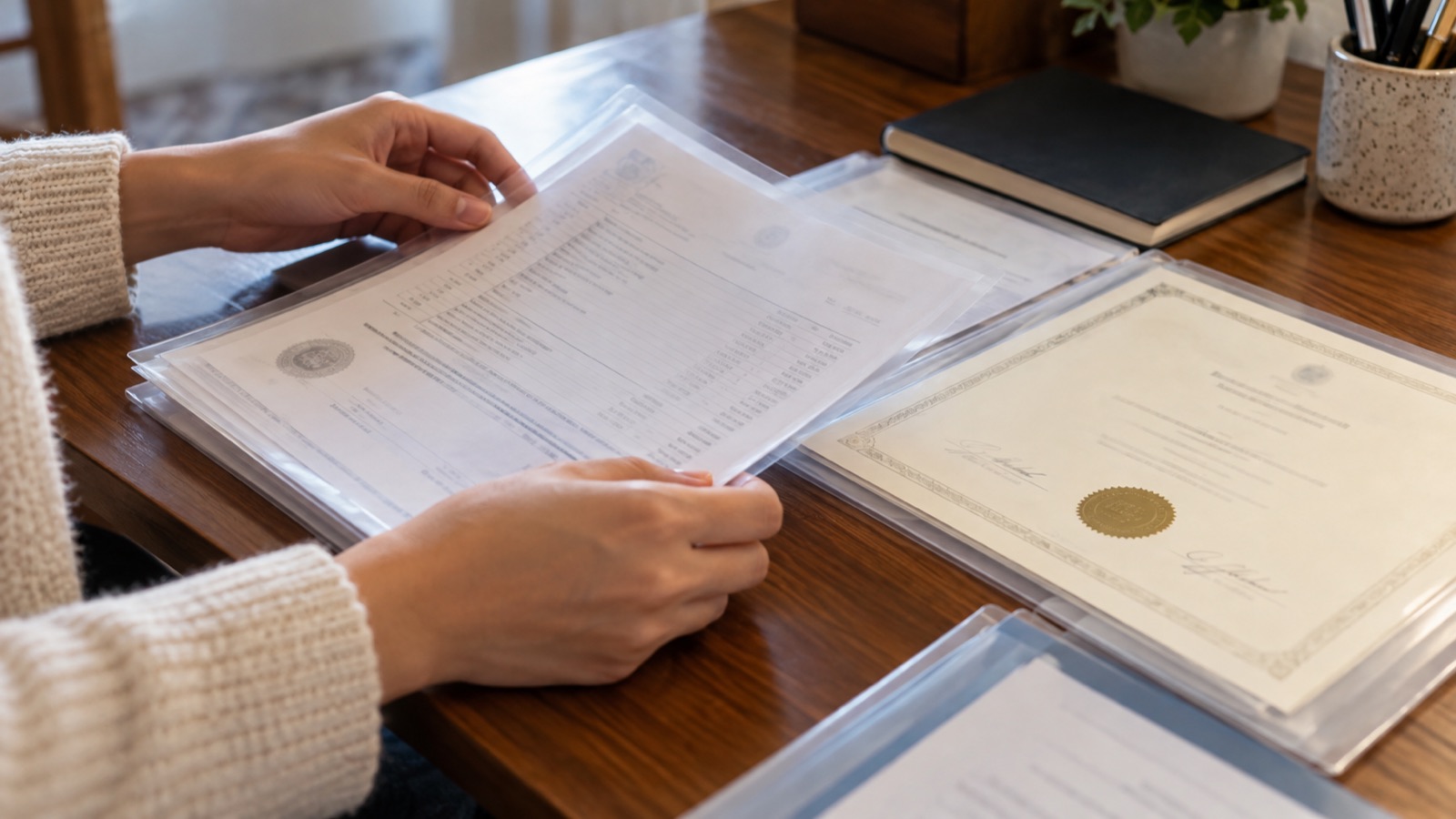
What degree am I working toward?
Before choosing a destination, write down the exact name of your programme, the name of every institution that will award a degree, and the institution that will issue your official transcript. Also keep a record of the dates and locations where you studied.
These models are not interchangeable. The University of Prince Edward Island (UPEI) describes its Cairo campus as a campus where students can earn the same UPEI degree as in Canada. Cape Breton University (CBU), for its part, describes a double-degree option with Canadian International College (CIC): when the applicable requirements are met, students can earn a degree from each institution. CIC also distinguishes a separate Egypt-only option.
For the CIC–CBU double-degree option, CBU states that students can complete the programme in Egypt or include a transfer or exchange. However, do not assume this description applies to your programme or an earlier cohort: ask the institutions to confirm your enrolment and the credentials you are expected to earn. CBU also offers a transcript request process for current and former CIC students.
Finally, the word “Canadian” in an institution’s name does not, by itself, prove that a Canadian university will award your degree. The useful question is always: who awards what, for my specific programme?
Transfer, exchange or a new application: which route should I choose?
| My situation | Route to explore | Decisive question |
|---|---|---|
| I am still an undergraduate and want to continue in Canada | Transfer to a Canadian campus or application to another institution | Which credits will be recognized, and which courses will I still need to take? |
| I want to study in Canada temporarily and then continue my original programme | Exchange | How long will the stay last, and how will the courses be recognized when I return? |
| I have completed my degree and want to continue studying | New application, for example to a master’s programme | How will the university assess my degree and the prerequisites for the programme I have chosen? |
An exchange is not simply a shorter transfer. For an exchange, check the arrangements for returning and get course approval before you leave. For a transfer, ask how accepted credits fit into the destination programme: recognized credits do not necessarily replace every required course.
The UPEI and CIC–CBU routes below are documented examples, not automatic entitlements for every student at a partner institution. For another university, the destination institution assesses your application and previous studies.
I’m at UPEI Cairo: can I go to Charlottetown?
EDIN’s FAQ describes a route to the Charlottetown campus after 30 credit hours, with a cumulative GPA of at least 1.7. It also mentions that applicants must be 18 or older. These benchmarks do not replace confirmation of your eligibility by UPEI: ask for written confirmation of the conditions that apply to your file, programme and cohort, particularly if you are 18. If you are also changing programmes, check its prerequisites.
Ask the Cairo and Charlottetown offices for an assessment of recognized credits, a plan of remaining courses, application dates, and an estimate of tuition and other fees. Continuity between campuses does not replace confirmation of your academic pathway or immigration procedures.
I’m at CIC: transfer or exchange to Cape Breton?
CBU and CIC publish two separate routes. The conditions below correspond to the pages reviewed on November 5, 2026: ask the institutions to confirm them for your cohort and programme.
| CIC–CBU transfer | CIC–CBU exchange | |
|---|---|---|
| CIC programme | According to CIC’s FAQ, students in the double-degree option can apply for this route | According to CIC’s FAQ, students in the double-degree option can apply for this route |
| Purpose | Continue at CBU, potentially through to graduation | Study at CBU for one or two terms |
| Previous study | At least one year at CIC, according to CBU | At least one year at CIC, according to CBU |
| Average | CBU states at least 65%; CIC refers to a cumulative average | CBU states at least 75%; CIC specifies 75% over the two previous semesters |
| Other points published by CBU | Proof of English proficiency and September intake | Proof of English proficiency and September intake; exchange not available in the final year |
CIC places the transfer in the second, third or fourth year, and the exchange in the second or third year. For the exchange, do not combine the two formulations of the 75% threshold: ask CIC and CBU which period and scale will be used for your file.
Confirm with both institutions which option you are enrolled in and which routes are available to your cohort. If you are in the Egypt-only option, that does not mean that every separate application to CBU is impossible: ask the university how it would assess your file.
For both a transfer and an exchange, ask for clarification about enrolment status, available courses, fees payable to each institution, and how results will appear on your transcripts.
After my degree: can I be admitted to a master’s programme?
You can present your academic background to a Canadian university and ask it to assess it. However, earning a Canadian degree after studying in Egypt does not guarantee admission, nor does it, by itself, tell you which equivalency scale the institution will use. Provide the exact degree title, the name of the awarding institution and the location of your studies before assuming that an equivalency scale intended for Egyptian or Canadian degrees applies.
As a benchmark for Egyptian credentials, Simon Fraser University lists, for master’s studies, a bachelor’s degree or licence, along with the benchmark “80% on a percentage scale, Very Good.” Ask the admissions office how it applies this benchmark to your grading scale. The University of Ottawa lists a bachelor’s degree or baccalaureos and “Good,” B, 70% or 3/4. These benchmarks are specific to two different institutions: they are neither universal conversions nor guarantees of admission. They do not automatically determine how a Canadian degree taught in Egypt will be assessed.
To compare your options without looking for a universal ranking, start with your field and your goal: are you looking for a course-based master’s or a research project? Then check the prerequisites, average, language of instruction, proof of language proficiency and programme-specific requirements. The University of Waterloo, for example, publishes general admission and English-language proficiency requirements; you must then check the requirements for the programme you are considering.
Ask whether your previous studies in English may qualify you for a test exemption. Do not assume that you will be exempt or that a particular score will be accepted: the rules of the institution and programme you choose apply.
What documents should I prepare, and what should I ask registrars?
Prepare a working file, then check the list and submission method required by each recipient:
- Degree earned or proof of current studies, with its exact title;
- Official transcripts from each relevant issuing institution and the grading scale;
- Course descriptions, credits and prerequisites, particularly for a transfer;
- Proof of language proficiency, if required;
- Translations and copies in accordance with the instructions of the university or Immigration, Refugees and Citizenship Canada (IRCC).
For a master’s application, also check the documents specific to the programme: they may differ from one application to another. Ask whether the transcript must be sent directly by the issuing institution and in what format.
You can write to the registrar or admissions office:
I am studying or have studied at [institution and campus in Egypt], in the [programme title] programme. The degree is or will be awarded by [awarding institution]. I want to [transfer, take part in an exchange or apply to a master’s programme] for the [intake]. How will you assess my degree or credits? Which transcripts, course descriptions and proof of language proficiency do you require, and who must send them to you?
Add questions that could affect your decision: how many courses would remain, what fees would apply to your international student status, what is the deadline, and when could you receive a written assessment? For an exchange, ask both institutions to approve your courses before you leave.
Budget and application from Egypt: admission and a permit are separate
Build your budget using an estimate from the host campus that corresponds to your programme, status and planned duration. Add housing, insurance, transportation, application costs and everyday expenses. For an exchange, ask separately which fees are paid in Egypt and in Canada, as well as the conditions for refunds or deferrals.
As proof of funds required by IRCC, the published amount for an application submitted on or after September 1, 2026, requires a single person studying outside Quebec to show $23,448 CAD for first-year living expenses, in addition to tuition and transportation. This is not a complete estimate of the actual cost. The amount depends, among other things, on the application date and family size; consult the amount in force when you apply. For a longer programme, you must also explain how you will fund the full duration.
Admission and a study permit are two separate decisions. From Egypt, a study permit application is generally submitted online before departure. Use IRCC’s instructions for an application from outside Canada and select Egypt to find the applicable local instructions. Prepare, in particular, your letter of acceptance, identity documents and proof of funds, as well as any other documents required for your situation.
A provincial or territorial attestation letter is generally required, but exemptions exist. IRCC provides, among other cases, an exemption for a master’s degree leading to a degree at a public designated learning institution and, subject to certain conditions, for exchanges where no tuition is paid to the Canadian institution. The word “exchange” alone is therefore not enough to establish an exemption. In Quebec, check the requirements for the Certificat d’acceptation du Québec (CAQ) separately. If you are claiming an exemption, follow IRCC’s instructions about the proof to provide.
For a short exchange, also check whether a permit is required or would be useful in your case. A university transfer does not automatically exempt you from travel or immigration formalities.
Will my studies in Egypt count toward working after graduation?
A degree bearing the name of a Canadian university does not automatically grant a post-graduation work permit. IRCC considers, among other things, the institution, programme and the individual’s study history.
IRCC describes a specific case in which a component completed abroad is credited by a Canadian school; in that case, the permit’s duration covers only the period studied in Canada. This does not mean that your programme necessarily falls into this case. Before choosing a transfer or master’s programme, check the rules that apply to your programme and situation, including those related to duration, status and language, as well as field of study when that condition applies. Separate rules may apply to distance learning.
Keep records of dates, campuses and credits. If your situation raises a personal legal question, have it reviewed by someone authorized to provide immigration advice. The rules may change between your application and the end of your studies.
My five-step plan
- Identify my programme: note the programme, campus, degree-awarding institution and issuer of each transcript.
- Choose my route: transfer, exchange or a new application after graduation; compare options based on my field and goal.
- Get written answers: ask the relevant institutions about admission requirements, language, credits, remaining courses, fees and timelines.
- Prepare my application and funding: gather the required documents and create a budget for the entire planned period.
- Check immigration separately: follow IRCC’s instructions from Egypt and wait for the necessary decisions before making departure arrangements on the assumption that admission or a permit has been granted.
University requirements and immigration rules can change. Review them when you apply and keep the answers specific to your file.