

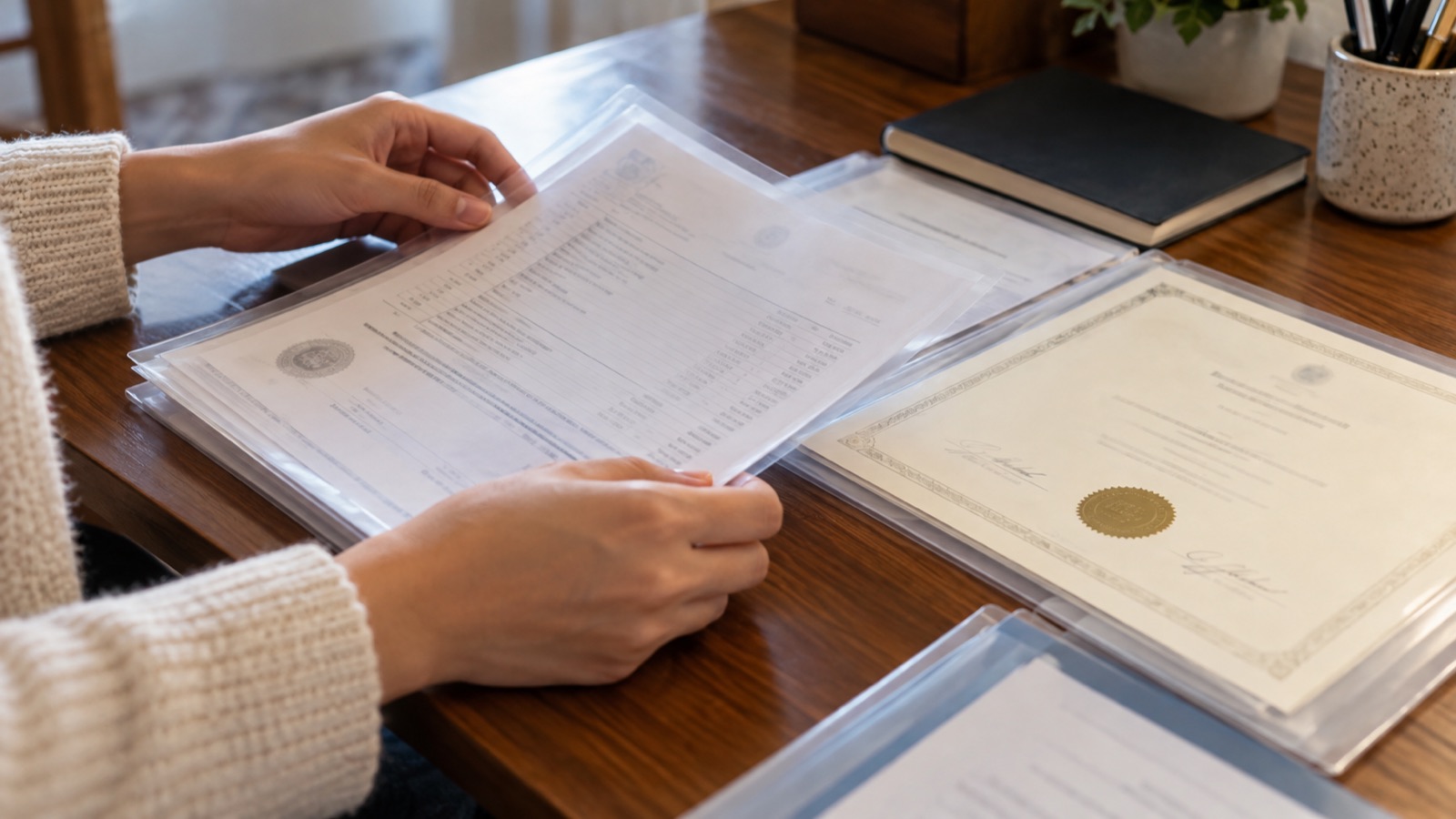
Egyptian credentials: a comparison, not a national equivalency
The name of your credential is a starting point, but you must also consider the level you are applying for, the years of study completed and the programme requirements. Two universities may set different conditions for the same academic background.
| Pathway | Example of a published criterion | What remains to be reviewed |
|---|---|---|
| Thanaweya a`Amma | Concordia University lists it as a minimum qualification for an undergraduate application from Egypt. | Grades and prerequisites for the programme selected. |
| Twelve years of pre-university education | For undergraduate studies, Université Laval also indicates one successfully completed year of higher education. | Programme requirements and, where applicable, the possibility of preparatory studies. |
| Baccalaureos | Laval lists it as the minimum credential for a master’s degree. | Other requirements for the master’s degree sought. |
| Magistr | Laval lists it as the minimum credential for a doctorate. | Other requirements for the doctorate sought. |
At Laval, preparatory studies may be considered when the stated requirements are not met, for the relevant non-quota programmes. These examples describe each institution’s rules: they are neither a ranking nor a single Canadian framework. A credential that meets the published minimum does not guarantee admission.
Universities and programmes: create a profile for each choice
The profiles for Université Laval and Concordia University are a place to start exploring the two institutions mentioned in this guide. Their profiles do not confirm that a specific programme is currently available or state its current requirements.
For each programme you are considering, record the requested credential, prerequisite subjects, language proof, documents, deadline and tuition fees in one profile. Then compare these elements with your academic background and when you will be able to provide your results. Confirm the information directly with the institution before applying.
Documents and language: prepare two applications
Gather your credentials and transcripts, then check what each university accepts at the time of application and what it requires after making an offer. For undergraduate admission, for example, Concordia accepts unofficial documents for the initial assessment; final official documents are then required before classes begin.
If your documents are in Arabic, review each recipient’s translation instructions before incurring any expenses. A translation prepared for admission may not meet the requirements for a permit application. Keep the documents in their original language as well.
For language requirements, first choose your programmes, then determine which test, if any, is required. For undergraduate studies, Concordia lists, among other options, an IELTS Academic score of 6, with no component below 5.5; some programmes require higher scores. At Laval, the TCF is a reference for applicants with a non-French-language academic background. Some DELF or TEF results less than two years old that include a written expression test may also be accepted.
Before booking an exam, check possible exemptions, the accepted test version, required results and their validity period. These examples are not national thresholds.
Permits: the Cairo checklist and attestations
A study permit application generally includes a letter of acceptance from a designated learning institution, proof of identity and proof of financial support. Other documents may be required depending on your situation. Admission and the permit decision are separate: an offer does not guarantee authorization to study.
IRCC publishes the supplementary IMM 5824 E checklist for the Cairo office, to be read together with the general IMM 5483 checklist. The version consulted is dated February 2026. It includes, among other things, a certified translation of documents that are not in English or French, a one-page study plan and a CV if more than two years have passed since your last full-time studies. This checklist is not exhaustive: check its version and whether it applies to your application, as well as any instructions received from IRCC.
A provincial or territorial attestation letter, called a PAL or TAL, is generally required, unless you are exempt. Since January 1, 2026, the exemption includes, among others, programmes leading to a master’s or doctoral degree at a public designated learning institution. It does not automatically apply to all graduate programmes.
In Quebec, when a provincial attestation is required, the attestation that a Certificat d’acceptation du Québec, or CAQ, has been issued serves as the PAL if it includes the wording required by IRCC: you should therefore not assume that a second, separate letter is necessary. Conversely, a federal PAL or TAL exemption does not automatically exempt you from the CAQ; most exempt applicants must still obtain one, subject to applicable exceptions.
Proof of funds: Quebec and other destinations
The amount you must demonstrate depends, among other things, on where you will study, the date of your application and the number of people concerned. The following guidelines are for one person; they do not represent the total cost of studies.
| Schedule | Published annual amount | Date and additional expenses |
|---|---|---|
| IRCC, outside Quebec | 23,448 CAD for living expenses | Applications submitted on or after September 1, 2026; tuition and transportation are additional. |
| Government of Quebec, financial capacity for temporary selection for studies | 24,617 CAD for essential needs | Applications submitted on or after January 1, 2026; tuition and round-trip transportation are additional. |
The categories do not cover exactly the same expenses. The Quebec budget includes, among other things, settlement costs and health and hospitalization insurance. Check the schedule in effect when you apply and the one that corresponds to your family size.
IRCC requires you to demonstrate that you have the necessary funds without relying on employment in Canada. For a programme lasting more than one year, you must also explain how you will fund the remainder. Bank statements for the past six months are among the federal examples of supporting documents; on their own, they are not a universally sufficient list.
The Cairo checklist also asks you to document a reliable source of funds that can be converted into Canadian dollars. Organize your documents according to the actual source of your funding and distinguish between aid you are considering and a scholarship that has actually been awarded.
Biometrics, fees and timelines: keep the steps separate
Biometrics exemptions exist. If IRCC asks you for fingerprints and a photo, follow the instruction letter you receive. The listed individual fee is 85 CAD; booking an appointment is free. The study permit fee is separate: 150 CAD. Other expenses, including translation or travel costs, may apply.
IRCC lists a visa application centre in Cairo. Check its contact information and the services available before travelling there.
For federal processing, consult IRCC’s processing times tool and select the appropriate application category and location. The result is an estimate that may change, not a guaranteed decision date.
In Quebec, the government states that it will make a decision within 25 business days for 80% of complete temporary selection applications for studies, starting when all required documents have been received. This provincial service standard is not the federal permit processing time.
In your calendar, enter separate dates for the availability of academic results, any language test, the application, applicable provincial procedures, the federal application and biometrics. Allow extra time for additional documents rather than adding estimates together as if they were promises.
Scholarships: a short exchange or a full degree?
Egypt is among the countries eligible for the Study in Canada Scholarships for the 2026-2027 cycle. This programme is for short-term exchanges for study or research: it is not a general scholarship that automatically covers a full degree.
Conditions include citizenship of an eligible country, full-time enrolment at a post-secondary institution in an eligible country, and payment of tuition fees to that institution during the exchange. Canadian institutions select participants and submit applications; direct individual applications are not accepted. The call consulted was closed.
If you are already studying in Egypt and are considering an exchange, contact your institution’s international relations office and check the requirements of any future call. For a full degree, look separately for funding from the Canadian institution and check what it covers before including it in your budget.