

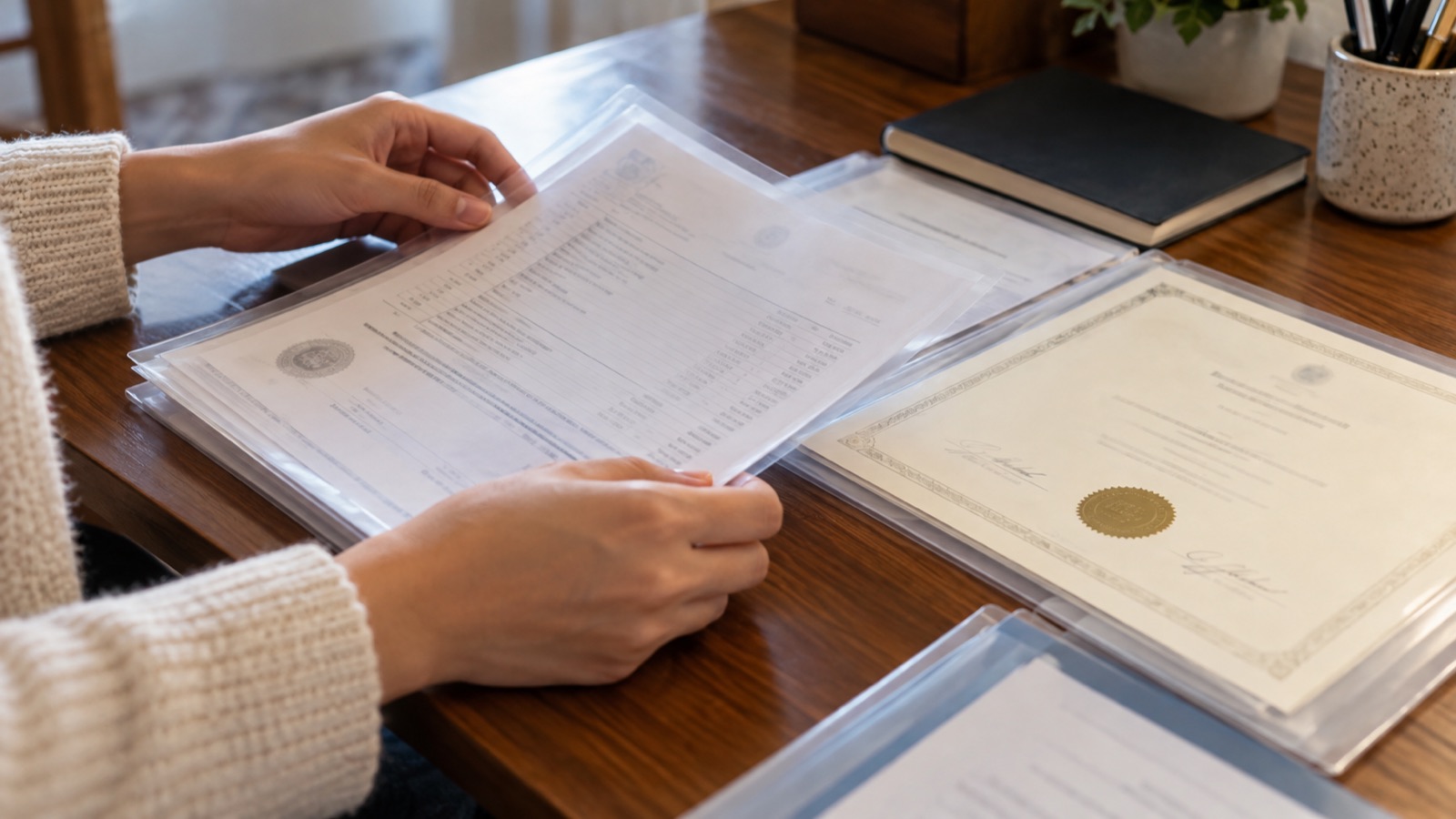
Lebanese credentials: understanding the required level
The word baccalauréat does not refer to the same level in both systems: the Lebanese baccalauréat is a secondary school graduation credential, while a Canadian bachelor's degree is an undergraduate degree. The similarity in names is therefore not enough to establish equivalency.
Institutions publish their own reference points. Here is how two universities assess certain Lebanese credentials:
| Your academic background | Published reference point | What you still need to check |
|---|---|---|
| Lebanese second-degree baccalauréat or technical baccalauréat | Université Laval classifies these among pre-university credentials totalling 12 years. For undergraduate studies, it also requires 1 successful year of postsecondary studies. | The possibility of preparatory studies and the programme requirements. |
| General or technical Lebanese baccalauréat | Concordia University lists these in its international secondary school credential chart. | Prerequisites and other undergraduate admission criteria. |
| Licence or bachelor's degree | Laval lists these, in particular, among the credentials considered for an application to a master's programme. | The requirements specific to the programme and application. |
| Master's degree | Laval mentions a master's degree and other credentials among the reference points for doctoral studies. | The exact degree and the criteria for the programme you are applying to. |
At Laval, preparatory studies may be considered in certain undergraduate cases, for programmes that are not subject to enrolment limits. These examples are neither a national equivalency framework nor a guarantee of admission.
Universities and programmes: building your comparison
If you are deciding between several programmes, first compare the requirements that apply to your academic background, rather than focusing only on the name of the credential. The following two profiles are starting points, not a ranking:
- Université Laval, in Québec City: its official chart includes a Lebanon section and distinguishes between study cycles.
- Concordia University, in Montréal: its undergraduate chart lists Lebanese secondary school credentials, and the university publishes its English requirements separately.
For each option, note the required credential, prerequisite subjects, language, documents, deadline and costs provided by the institution. If you are also considering a programme outside Québec, ask the institution concerned the same questions. StudyCanada profiles do not confirm whether a specific programme is currently open or its current admission requirements.
French or English: do you need to take a test?
Before booking an exam, check the language of instruction and the evidence accepted by the university. Your nationality alone does not determine whether a test will be required.
At Laval, DELF or TEF results less than 2 years old, including written expression, may be accepted, among other options. The required level and other ways to demonstrate knowledge of French must be reviewed according to your situation and programme.
At Concordia, for undergraduate studies, IELTS Academic is one possible form of evidence. The general minimum listed is 6.0, with no component below 5.5; the result must be less than 2 years old at the time of application. Some programmes require higher scores.
Concordia provides, among other things, an exception for 3 full years at an accredited secondary or postsecondary institution where English is the sole language of instruction. Bilingual schooling does not automatically meet this description, and the institution may require a test. None of these examples is a threshold that applies throughout Canada.
Documents: preparing 2 applications from Lebanon
The university and immigration authorities assess separate applications. Ask each institution which credentials and transcripts it expects, in what form and by what date. For a study permit, Immigration, Refugees and Citizenship Canada (IRCC) requires, among other things, a letter of acceptance, proof of identity and proof of financial resources.
The federal application package selected for Lebanon also refers to the additional checklist IMM 5820 from the visa office in Beirut, version of February 2026. It lists, among other things:
- an extract from the civil register, certified by the head of the civil section of the Mohafazat, and its translation;
- a police certificate accompanied by a translation;
- proof of status in Lebanon for people who are not Lebanese citizens;
- where applicable, the most recent diploma obtained or, failing that, the most recent transcript certified by the Ministry of Education.
This list of examples is not exhaustive. Read the local checklist together with the general instructions and the instructions for your application. Check the translation requirements of the university, IRCC and, where applicable, Québec separately: a translation prepared for one recipient does not necessarily meet another recipient's instructions.
Admission, attestation and CAQ: separate steps
A letter of acceptance is not approval of a study permit. A provincial or territorial attestation letter is generally required in the federal application, unless an exemption applies.
Since January 1, 2026, an exemption applies, among other cases, to programmes leading to a master's or doctoral degree at a public designated learning institution. It does not automatically extend to all graduate programmes: check the exact category of your programme.
For Québec, the attestation of issuance of the Certificat d’acceptation du Québec (CAQ) may serve as a provincial attestation letter when it meets federal requirements. An exemption from the attestation letter does not necessarily remove the provincial CAQ requirement. Review the Québec and federal rules that apply to your situation separately.
Proof of funds: Québec or another province?
The amount you must demonstrate depends, among other things, on your destination, the date of submission and the number of people concerned. For 1 person, the annual amounts consulted are:
| Destination and application date | Reference amount | Expenses to add |
|---|---|---|
| Outside Québec, as of September 1, 2026 | CA$23,448 for living expenses | Tuition fees and transportation |
| Québec, as of January 1, 2026 | CA$24,617 for essential needs | Tuition fees and international transportation |
The 2 categories do not cover exactly the same items: in Québec, essential needs include, among other things, insurance and local transportation. Neither figure represents the total cost of a study plan on its own. Amounts also vary according to the composition of the family application; consult the amount that applies to your situation.
IRCC requires you to demonstrate sufficient resources without relying on work in Canada. For a programme lasting more than 1 year, you must also explain how you will finance the remainder. The Beirut checklist asks, among other things, for documents showing a reliable source of funds that can be converted into Canadian dollars.
To put your application together, distinguish between the amount required, the source of the funds and the supporting documents that provide evidence of them. Do not assume that a particular bank balance is necessarily available or transferable. Consult the general financial instructions, the Beirut checklist and the instructions specific to your application together.
Biometrics, fees and processing times: organizing your timeline
If biometrics are requested, wait for IRCC's instruction letter and follow its directions to provide your fingerprints and photo. IRCC normally allows 30 days after receiving the letter. This deadline is for providing biometrics, not for a decision on the permit.
IRCC lists a visa application centre in Beirut. Booking a biometrics appointment is free; check the services and hours before travelling, and do not assume an appointment will be available on your preferred date.
In the fee schedules consulted, federal fees are CA$150 per person for a study permit and CA$85 for individual biometrics, when required. Exemptions, family rules or other expenses may apply.
In Québec, the fee to assess an application for temporary selection for studies is CA$135 as of January 1, 2026. The province indicates a decision within 25 business days for 80% of complete applications, starting when all documents have been received. This is neither a guaranteed maximum nor the processing time for the federal permit.
For the latter, consult IRCC's dynamic tool and select the relevant application type and circumstances. The estimate is not a guaranteed date. In your timeline, separate the university application, tests and translations, attestations, federal application and any required biometrics.
Scholarships and exemptions: a Québec–Lebanon option
An exemption from additional tuition fees is not the same as a living-expenses scholarship: it affects the fees charged and does not necessarily cover the entire stay.
Lebanon is among the countries covered by Québec's exemption agreements. For this assistance, Québec indicates, among other things, continuous full-time enrolment in the fall and winter terms in a university programme leading to a degree, the required authorizations and a recommendation from the designated official. The exemption is not automatic.
In its August 2026 directory, Québec identifies the Lebanese Ministry of Education and Higher Education in Beirut as the responsible authority for Lebanon. Contact it for useful contact details, conditions and the application timeline. Do not count assistance you are considering as funding that has already been obtained.
Finally, the temporary federal special measures described by IRCC for certain people affected by the crisis in Lebanon have been closed to new applications since August 1, 2025. This closure concerns those specific measures, not all study applications. To move forward, link each step to its own timeline: assessment of your academic background, application, financing, attestations and permit.