

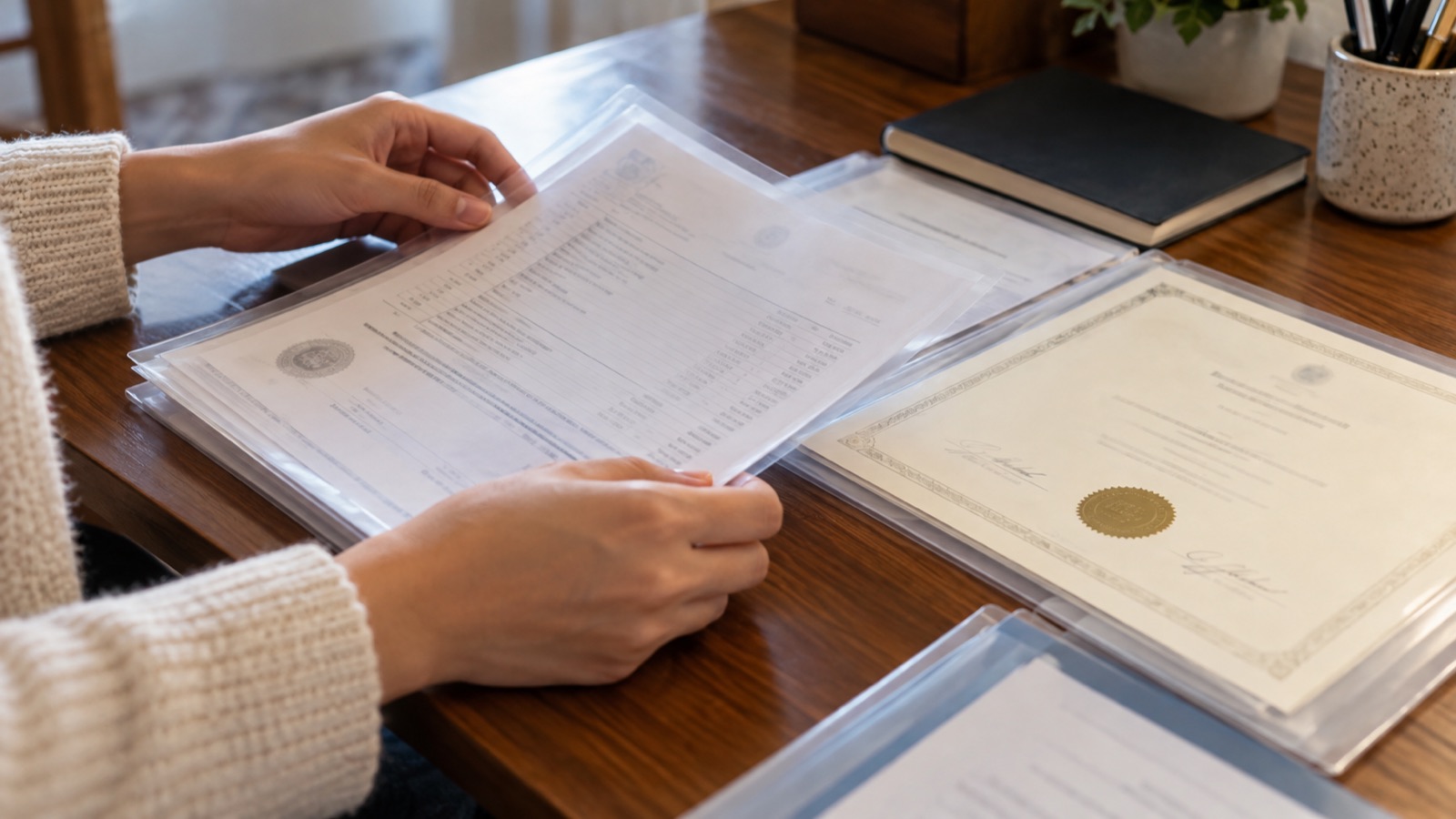
Understanding your Algerian diploma
The word “baccalauréat” does not necessarily refer to the same level in both systems. In its terminology table, the University of Ottawa compares the Algerian secondary-school baccalauréat to the Canadian high school diploma. This is a reference point, not an automatic individual equivalency or a guarantee of admission.
Université Laval, for its part, publishes the following minimum diplomas for people educated in Algeria:
| Level sought at Laval | Minimum diploma indicated |
|---|---|
| Undergraduate | Secondary Education Baccalauréat or DEUA |
| Master’s or DESS | Licence |
| Doctoral | Magister or master |
For undergraduate studies, Laval also indicates 1 year of postsecondary studies after 12 years of pre-university schooling. If the requirements are not met, preparatory studies may be necessary; these apply only to non-quota programs. Requirements specific to each program should still be checked.
Diploma types also matter. The University of Ottawa indicates that a technical or technological baccalauréat is not an acceptable basis for admission to its undergraduate programs. This restriction is specific to Ottawa: it does not allow conclusions to be drawn about another university.
To start your comparison, note the exact name of your diploma, the years of study completed and the subjects you took. Then review the requirements for the level and program that interest you.
Preparing two sets of documents
The institution and immigration authorities do not necessarily assess the same documents. Prepare one checklist for admission and another for the permit.
For undergraduate studies, the University of Ottawa distinguishes among applicants still in their final year of secondary school, those who have earned their baccalauréat and those who have undertaken postsecondary studies. Depending on the applicant’s background, the university requests secondary-school report cards, baccalauréat examination results or postsecondary transcripts. Consult the list for each institution before preparing your submissions.
For a study permit, the Immigration, Refugees and Citizenship Canada, or IRCC, application package selected for Algeria refers to the additional checklist IMM 0152, intended for residents of Algeria. It requests, among other things, the most recent diploma or certificate and the corresponding transcripts. Read it together with the federal guide and the instructions that apply to your application.
If a document for the permit is written in neither French nor English, the local checklist requires a certified translation. The federal guide also requires an affidavit when the translator is not certified in Canada. The applicant and their family members cannot translate documents for IRCC. Check the institution’s instructions separately before arranging your translations.
French or English: What evidence should you prepare?
University language requirements and study permit instructions may differ. Before booking a test, check with each recipient which evidence is accepted, which version of the test is required and its validity period.
For undergraduate studies, the University of Ottawa includes Algeria among the locations that may qualify for an exemption from the French test. The university indicates, among other criteria, 3 years of full-time study including postsecondary studies in French, or the final 3 years of secondary school in French at an institution where French is the sole language of instruction, except for language courses. It may nevertheless request a test or refuse the exemption: nationality alone is not sufficient. If in doubt, contact its admissions office.
The federal IMM 0152 checklist requests test results from tests taken within the last 24 months. It lists TCF Canada and TEF Canada for studies in French, and IELTS General Training, CELPIP-G and PTE Core for studies in English. It also mentions a letter from the institution confirming that the applicant’s studies were conducted in the language of the proposed studies as possible language evidence, and then refers to uploading results or other proof of proficiency.
These statements do not establish that a test and a letter are always required together, or that the letter automatically exempts you from the test. Check with IRCC which evidence applies to your file before booking a test. The university may accept other tests or versions for admission.
Universities and programs: Making a comparison
The StudyCanada profiles for Université Laval and the University of Ottawa offer two starting points. Laval’s official information provides diploma benchmarks by level; Ottawa’s details, among other things, the academic documents and language requirements for undergraduate studies.
For each program you are considering, note the required diploma, prerequisite subjects, language, documents, deadline and fees. Then compare these with your background and the date when you will be able to obtain your transcripts.
Confirm the requirements with the institution: a university profile does not prove that a specific program is currently accepting applications or that your application will be admitted.
From admission to attestations and a study permit
Study permit documents include, among other things, a letter of acceptance from a designated learning institution, proof of identity and proof of financial support. This list is not exhaustive: the documents to provide depend on your situation and the applicable instructions.
A provincial or territorial attestation letter, or PAL/TAL, is generally required, subject to exceptions. Since January 1, 2026, an exemption applies, among other cases, to programs leading to a master’s or doctoral degree at a public designated learning institution. It does not automatically extend to all graduate programs.
For a plan in Quebec, distinguish between the provincial and federal processes. The attestation confirming issuance of the Certificat d’acceptation du Québec, or CAQ, with the required wording generally serves as a PAL/TAL. Most people exempt from this federal attestation must nevertheless obtain a CAQ to study in Quebec, subject to exceptions. Check the requirements that apply to your situation.
Proof of funds: Distinguishing the benchmarks
IRCC requires you to demonstrate that you can pay tuition, living expenses and transportation without relying on work in Canada. For a program lasting more than 1 year, you must also explain how you will fund the rest of your studies.
The following benchmarks apply to one person, but relate to two different processes and categories of expenses:
| Process and date | Reference amount | Expenses to budget separately |
|---|---|---|
| Federal study permit outside Quebec, application submitted on or after September 1, 2026 | 23,448 CAD for living expenses for the first year | Tuition and transportation |
| Quebec temporary selection for studies, application submitted on or after January 1, 2026 | 24,617 CAD for essential needs per year | Tuition and round-trip transportation |
These figures do not represent the total cost of the plan. In Quebec, essential needs include, among other things, settling-in costs and health and hospitalization insurance. Amounts vary according to the number of people included: consult the applicable table when you apply.
The federal checklist for residents of Algeria requests documentation of income, available funds and their source. It lists, among other things, bank transactions for the 6 months before the application and, depending on the file, certificates from the CNAS, CASNOS or CNR. If someone close to you or a scholarship contributes to your funding, review the supporting documents required for that assistance.
To build your budget, separate tuition, essential needs and travel, then match each resource with evidence. An anticipated contribution is not an amount that has already been granted.
Biometrics, fees and processing times: Planning the steps
IRCC lists a visa application centre in Algiers. If you are asked to provide biometrics, follow the instruction letter and check the services and appointments before travelling. IRCC says to provide biometrics as soon as possible, within 30 days of receiving the request for biometrics. This deadline is for collection, not for a decision on the permit.
The federal fees displayed at the time of consultation were 150 CAD for a study permit and 85 CAD for individual biometrics, when required and subject to a fee. Other expenses may also apply, including translation and travel costs.
To estimate study permit processing time, consult IRCC’s tool and select the study permit requested from outside Canada and Algeria. The result is an estimate, not a maximum or a guarantee.
In your timeline, enter the application deadline, the date you expect to obtain your academic documents, any language tests, applicable attestations, submission of the permit application and biometrics if requested as separate steps. The study permit processing time alone does not represent the entire preparation period for your plan.
Scholarships: Distinguishing short-term mobility from a full degree
The Study in Canada Scholarships program, presented by EduCanada, included Algeria among the eligible countries for the 2026-2027 cycle. It covered short-term study or research mobility, not automatic funding for a full degree.
Eligibility requirements included citizenship of an eligible country and full-time enrolment at a postsecondary institution in an eligible country. Other requirements and exclusions applied. Canadian institutions selected participants and submitted applications: individuals could not apply directly under this call.
The institutional deadline was March 31, 2026: this call is closed. If you are considering mobility, ask the international offices at the institutions concerned and check for any future calls, without assuming their requirements will be the same.
For a full degree, separately review the assistance offered by your chosen institution and what it covers. Assistance intended for tuition does not necessarily cover living expenses and transportation.