

Which Belgian diploma for which application?
Start by noting the exact name of your diploma, your stream, the subjects you studied and the level of study you are aiming for. This will allow a university to assess your background according to its own requirements, rather than on the basis of an assumed conversion of your diploma.
Université Laval lists three Belgian secondary school credentials in particular: the Certificat d’enseignement secondaire supérieur général, or CESS, the Diploma van Secundair Onderwijs and the Abschlusszeugnis der Oberstufe des Sekundarunterrichts. This does not mean it applies the same admission rule to every programme.
For the general CESS from the French Community, Laval provides a basis for direct admission to many undergraduate programmes. However, some faculties require a qualifying year, particularly in science and engineering. Prerequisites and other programme criteria still apply: being eligible for an application review does not guarantee a place.
At the University of Ottawa / Université d’Ottawa, the published pathway for students in the rhetoric year in the Fédération Wallonie-Bruxelles takes the general CESS and prerequisites into account, among other things. If you have another diploma or have already started postsecondary studies, ask the university which category applies to your background. Do not automatically apply the requirements for the rhetoric-year pathway to your application.
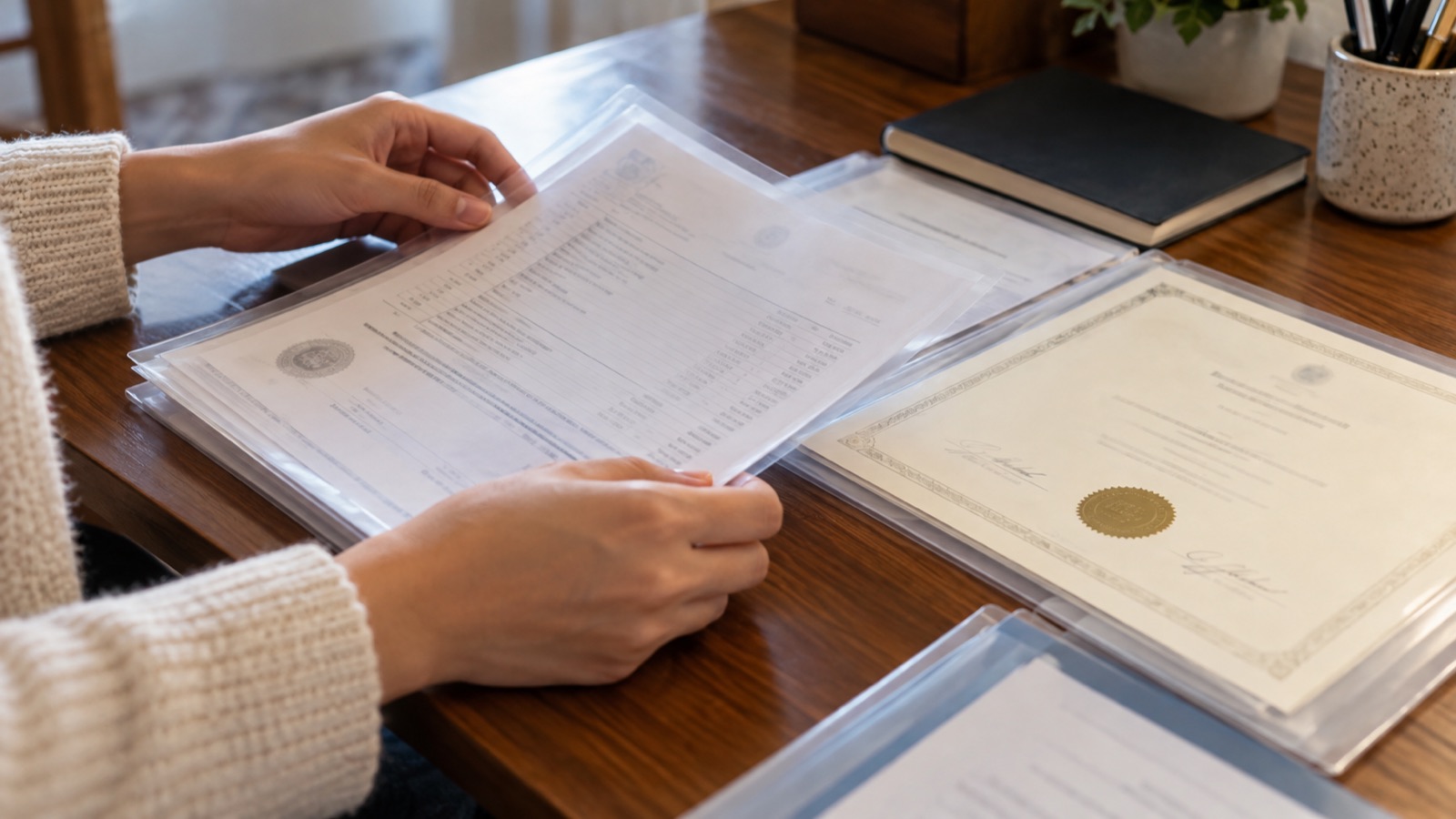
Documents and language: prepare two separate files
The university reviews your application; immigration authorities review the documents required for your authorization application. Make a list for each recipient before ordering copies or translations.
For example, Ottawa’s French-language page asks students currently in the rhetoric year to provide report cards for their fourth and fifth years, as well as those for the first semester of the rhetoric year. Confirm with the university which documents and period you need to submit. A separate list applies to people who have started postsecondary studies.
For a federal application, documents that are not in French or English must be accompanied by a translation that complies with the instructions of Immigration, Refugees and Citizenship Canada, or IRCC. Quebec and the university each have their own document requirements. If your report cards are in Dutch or German, compare these requirements before having your documents translated.
Do you need to take a language test?
Belgian citizenship alone is not enough to establish an exemption. For undergraduate studies, Ottawa provides, among other things, a possible exemption from the French test based on 3 years of eligible full-time study: postsecondary studies or the last 3 years of secondary school, in a country where French is an official language and at an institution where French is the sole language of instruction, except for language courses. The university may nevertheless require a test.
Ottawa also specifies that TCF Canada and TEF Canada versions are not accepted for the university admission described on its page. A test intended for immigration is therefore not necessarily the test required by the institution. For a programme in French or English, check which test is accepted, its version and validity, and the applicable thresholds before booking an exam.
Universities and programmes: build your comparison
Three StudyCanada profiles can help you start exploring institutions. They are neither a ranking nor a guarantee of access to a specific programme.
| Institution | Useful point of comparison |
|---|---|
| Université Laval | Its documentation distinguishes between Belgian diplomas and programmes that may require a qualifying year. |
| University of Ottawa / Université d’Ottawa | Its undergraduate pages outline academic documents and language requirements. |
| Université de Sherbrooke | Its insurance documentation identifies a Belgian document for people covered by an agreement. |
For each programme you are considering, enter the accepted diploma, prerequisite subjects, language, missing documents, deadline and fees communicated by the institution in a personal table. A qualifying year or additional test may change your timeline: check these points before deciding between destinations.
Admission, attestation and permit: who requests what?
A study permit is generally required for a long-term study plan. Exceptions exist, including for some short programmes: use IRCC’s tool to check the criteria that apply to your plans.
A study permit application generally includes a letter of acceptance from a designated learning institution, proof of financial support and a provincial or territorial attestation letter, known as a PAL or TAL. Exemptions from this attestation exist, including for certain programmes leading to a master’s or doctoral degree at a designated public institution. These exemptions do not automatically apply to all graduate studies.
In Quebec, also check whether you need a Certificat d’acceptation du Québec, or CAQ. When the federal attestation is required, the CAQ issuance attestation can meet the requirement if it includes the required wording: a separate second provincial letter is therefore not necessarily required. Conversely, a federal exemption from a PAL or TAL does not automatically eliminate Quebec’s CAQ requirement.
Quebec also applies caps on temporary selection applications to certain categories and institutions, with exemptions. Check the situation for your chosen institution before setting your timeline. Admission and the decision on a study permit remain two separate decisions.
Proof of funds: distinguish the threshold from the total budget
The following amounts apply to one person. They do not represent all the expenses of a study stay and do not cover exactly the same items.
| Framework | Annual amount | Date and separate expenses |
|---|---|---|
| Outside Quebec — ordinary federal threshold | 23,448 CAD for living expenses | Applications submitted from September 1, 2026; tuition and transportation are extra. |
| Quebec — temporary selection for studies | 24,617 CAD for essential needs | Applications submitted from January 1, 2026; tuition and round-trip transportation are extra. |
Some federal pilot programmes have separate financial rules. In Quebec, essential needs include, among other things, settlement and health and hospitalization insurance. Amounts also vary according to the number of people concerned: consult the threshold that applies to your application, and do not use this table as a ranking of the cost of living.
For studies lasting less than 1 year, the federal guide asks for proof of financial support for the duration of the studies. For a programme lasting at least 1 year, you must demonstrate that you have the resources needed for the first year; if it lasts longer, you must also explain how the rest will be financed. You must demonstrate your resources without relying on employment in Canada.
Bank statements, a scholarship, a loan or financial support are examples of possible proof. If you use bank statements, check the period and the supporting documents for the source of funds requested by IRCC. At the same time, prepare a budget that includes tuition, housing, insurance and travel: an administrative threshold is not a personalized quote.
Quebec tuition rates and scholarships: what options are available from Belgium?
Under an international agreement, Quebec offers preferential tuition rates to eligible French-speaking Belgians enrolled full-time in an eligible university programme. At the undergraduate level, the Canadian rate for non-Quebec residents may apply without an additional surcharge; at the second and third cycles, the rate may be the one charged to Quebec students. This does not mean that studies are free.
Requirements include, among other things, a valid Belgian passport, the required authorizations and proof of French-speaking status. The programme described by Quebec excludes people who hold both Canadian and Belgian citizenship. Residence in Belgium alone is therefore not enough to determine the rate. Ask the institution which documents it requires and which rate applies to your situation.
An exemption from additional tuition fees is not a scholarship. For research funding, Wallonie-Bruxelles au Canada presents WBI World for certain third-cycle stays and notes that WBI-MITACS Globalink has been suspended. The presentation of WBI World does not confirm that an application period is open: check the requirements and timeline for the competition that interests you.
The official EduCanada portal and the international office at your Belgian institution are other places to start. In your financial plan, distinguish between funding you are considering and funding that has already been awarded and documented.
Biometrics, fees and timelines: plan the steps
If IRCC asks for your fingerprints and photo, follow the biometric instruction letter and check the appointment arrangements. Biometrics and study permit processing are two different steps.
| Procedure | Fees shown at the time of consultation |
|---|---|
| Study permit | 150 CAD |
| Individual biometrics, when required | 85 CAD |
| Temporary selection for studies in Quebec | 135 CAD in 2026 |
Other expenses may apply, including university fees, translations and travel.
For temporary selection, Quebec indicates that it makes a decision in 25 business days for 80% of complete applications, starting when it receives all required documents. This indicator does not guarantee an individual outcome and does not include federal study permit processing.
For the latter, consult IRCC’s current tool and select the relevant application category and country. The estimate can change and does not guarantee a decision date. In your timeline, separate the university application, any language tests, attestations, study permit application and biometrics.
Before departure: check your insurance
If you are going to Quebec, find out before departure whether the social security agreement between Belgium and Quebec may apply to you. In its documentation for people enrolled in a regular programme and coming from a country with a reciprocal agreement, Université de Sherbrooke identifies the Belgian form BE-QUE 128.
Your Belgian health insurance organization and the Quebec authorities can clarify the steps and supporting documents suited to your situation. Check the dates and extent of coverage, as well as whether supplementary insurance would be useful: the existence of an agreement or a form does not guarantee automatic or comprehensive coverage.