

Choose a way to understand phenomena
Physics seeks to describe and explain phenomena using models, reasoning and observations. Studying this field requires connecting abstract ideas with results that can be examined. Interest in the universe's big questions can be a starting point, but everyday work also includes exercises, measurements, programming and careful reading of assumptions.
The physics program presented by UBC Science highlights using scientific concepts and principles in new situations. To choose your training, look at how this ability develops: mathematical progression, laboratories, theoretical courses and projects. Pathways may give different weight to experimentation, computation or a specialisation.
To test your interest, take a simple observation and try to formulate several possible explanations. Which measurements would distinguish them? Which assumptions simplify the problem? This questioning is more representative of the discipline than a collection of surprising facts. It helps you see whether you enjoy building and testing an explanation.
Compare theory, experiment and computation
A theoretical approach uses models and mathematical tools to understand relationships between phenomena. An experimental approach designs or uses measurement equipment. Computation helps explore models, process data and study situations difficult to solve directly. These dimensions complement one another, and foundational training needs to let you understand their connections.
Do not choose a direction solely because an activity seems more prestigious. Look at what you enjoy doing: proving, measuring, building, programming or interpreting. Early years can help clarify this preference. Ask when specialisation occurs and which foundations remain shared.
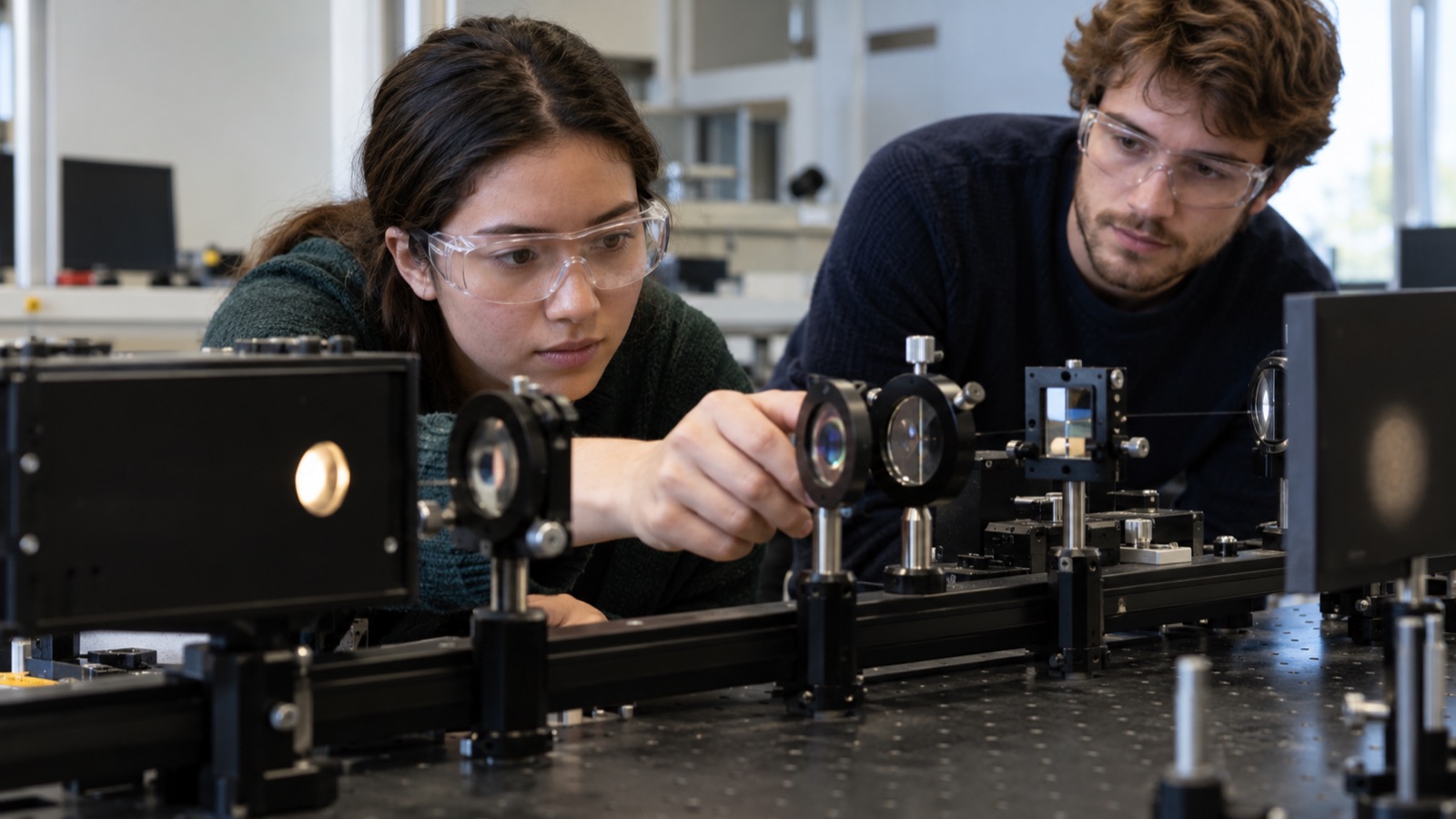
Application fields are varied. The presentation of the physics and astronomy co-op pathway at UBC mentions optics, electronics and several areas of physics. This example shows possible variety without guaranteeing a placement or a specific activity. Check options and conditions in your own program.
Strengthen mathematical tools
In physics, mathematics expresses relationships and examines their consequences. You therefore need to understand tools, rather than only memorise procedures. Before classes begin, compare prior learning against program prerequisites. Ask about upgrading if some concepts have not been studied or have received little practice.
Work by explaining the steps in reasoning. What does each variable represent? Which units are used? Under which conditions is the relationship valid? A numerical answer can seem correct while relying on an unsuitable assumption. Checking units and orders of magnitude helps detect these inconsistencies.
You will sometimes encounter a mathematical concept before clearly seeing all its applications. Look for the link with physical problems and ask questions. An initial difficulty does not necessarily mean the field is unsuitable for you. It may indicate a need for practice or a foundation to revisit more systematically.
Learn to measure and interpret
A physics laboratory teaches you to connect equipment, a procedure and a result. You need to understand what the instrument actually measures, how it is adjusted and which limitations affect the observation. Displayed precision must not be confused with certainty about the phenomenon. Documenting conditions allows rigorous discussion of the result.
Fictional example: a team measures movement using a video. It needs to define the scale, identify times and choose tracked points. A difference between the resulting curve and the model may have several causes. The task is to examine them and propose a test, rather than delete data that seems inconvenient.
Ask how reports are assessed. Clear analysis of uncertainties and limitations should play an important role. The aim is not to say everything worked perfectly, but to show you understand the process. This skill becomes valuable in research and activities where decisions depend on measurements.
Use computation critically
Programming can help process observations or explore a model. Start with simple cases whose behaviour is known, then increase complexity. If a result seems surprising, first check code, parameters and assumptions. A computer-generated curve does not replace a physical explanation.
Keep a record of versions, data and calculation choices. You need to be able to trace how a result was obtained. In group work, describe your tool's inputs, outputs and limitations. Someone taking over your work needs to understand what can be changed and what must remain consistent.
Follow course rules on assistance tools and shared work. Use resources to learn, then check you can explain each step. Scientific computing develops reasoning and verification skills; it does not mean delegating a question to software and accepting its answer without examination.
Explore research and related pathways
If research appeals to you, ask how students discover teams and projects. An introduction can show you work behind published results: preparation, trials, analysis and discussion. Check prerequisites, expected time and supervision. A university's large laboratory does not mean every student will participate.
Also compare physics with related pathways such as engineering, mathematics or certain applied sciences. A physics program may develop deep understanding without automatically constituting the required professional route for a regulated title. If your project depends on a right to practise, consult the appropriate body before choosing.
For further study at master's or doctoral level, look at advanced courses, research experiences and target programs' requirements. Interest in a specialised topic may evolve. Keep a sufficiently solid foundation to explore several directions while gradually building expertise you can demonstrate.
Prepare manageable studies and a clear next step
Examine laboratory schedules, required personal equipment and software provided. Add any travel or projects to the budget. Also prepare the working language: explaining reasoning, writing a report and discussing an assumption are part of study. These tasks require different practice from everyday conversation.
Throughout the pathway, keep authorised work showing your ability to model, measure, program and communicate. Describe your contribution and the analysis's limitations. This will let you explain your training to a laboratory, employer or another institution. The pathway's value becomes visible when you connect knowledge with methods you know how to apply rigorously.
Before comparing two offerings, build a fictional week from their schedules: classes, laboratory preparation, problem solving and writing. Identify periods when several assignments are due together. This small exercise reveals concrete needs, such as accommodation near campus or regular support sessions. It also allows discussion of the actual workload with the academic coordinator, instead of judging training solely by the number of listed courses.