

Understand a field connecting energy, signals and systems
Electrical and electronic engineering can lead to work on energy production and use, circuits, communications, sensors or system control. Programs give different weight to these dimensions. To choose, look at problems you want to learn to analyse and things you would like to design, rather than solely a technology sector's appeal.
The presentation of electrical engineering at Polytechnique Montréal lets you explore an example of a university pathway in this field. Use course outlines to compare foundations, laboratories and directions. The same title can conceal different choices of specialisation and progression.
If you enjoy technical objects, ask what interests you about how they work. Do you want to understand a signal, choose components, model a system or solve a power supply problem? These questions will help you distinguish engineering education from a related technical pathway and choose a suitable depth of study.
Distinguish a qualification, accreditation and the right to practise
In Canada, a qualification and a professional licence are related but distinct matters. Engineers Canada explains that licences to practise are issued by provincial and territorial bodies. The body in the place where you wish to practise is therefore the contact for requirements applicable to your pathway.
Check the exact program's status, its accreditation period where relevant and conditions for your intended professional route. Do not infer all these elements from the university's name. For someone already qualified abroad, the procedure may differ from that for a new Canadian graduate. Present your complete situation before choosing additional training.
If you plan to work in your home country, also check recognition with the appropriate authority. Training useful in Canada does not automatically bring every right elsewhere. This step needs to inform your initial choice, especially when the project depends on a professional title or reserved activities.
Prepare mathematical and physical foundations
Advanced courses rely on foundations that need to be sufficiently sound. Read prerequisites and compare them with your previous training. Mathematics helps represent and analyse systems; physics helps explain the phenomena models describe. An unaddressed gap can make a problem much harder than it actually is.
In preparation, revisit exercises while explaining steps, units and assumptions. Do not settle for a numerical answer. Ask whether the order of magnitude seems consistent and what would change if a condition varied. This habit connects calculation with understanding the system instead of mechanically applying a formula.
Programming and simulation tools may also be involved. Check what the program teaches and what it assumes you already know. A simulation can help explore behaviour, but needs interpreting through the chosen model and its limitations. A result displayed by software is not sufficient validation by itself.
Examine laboratories and design
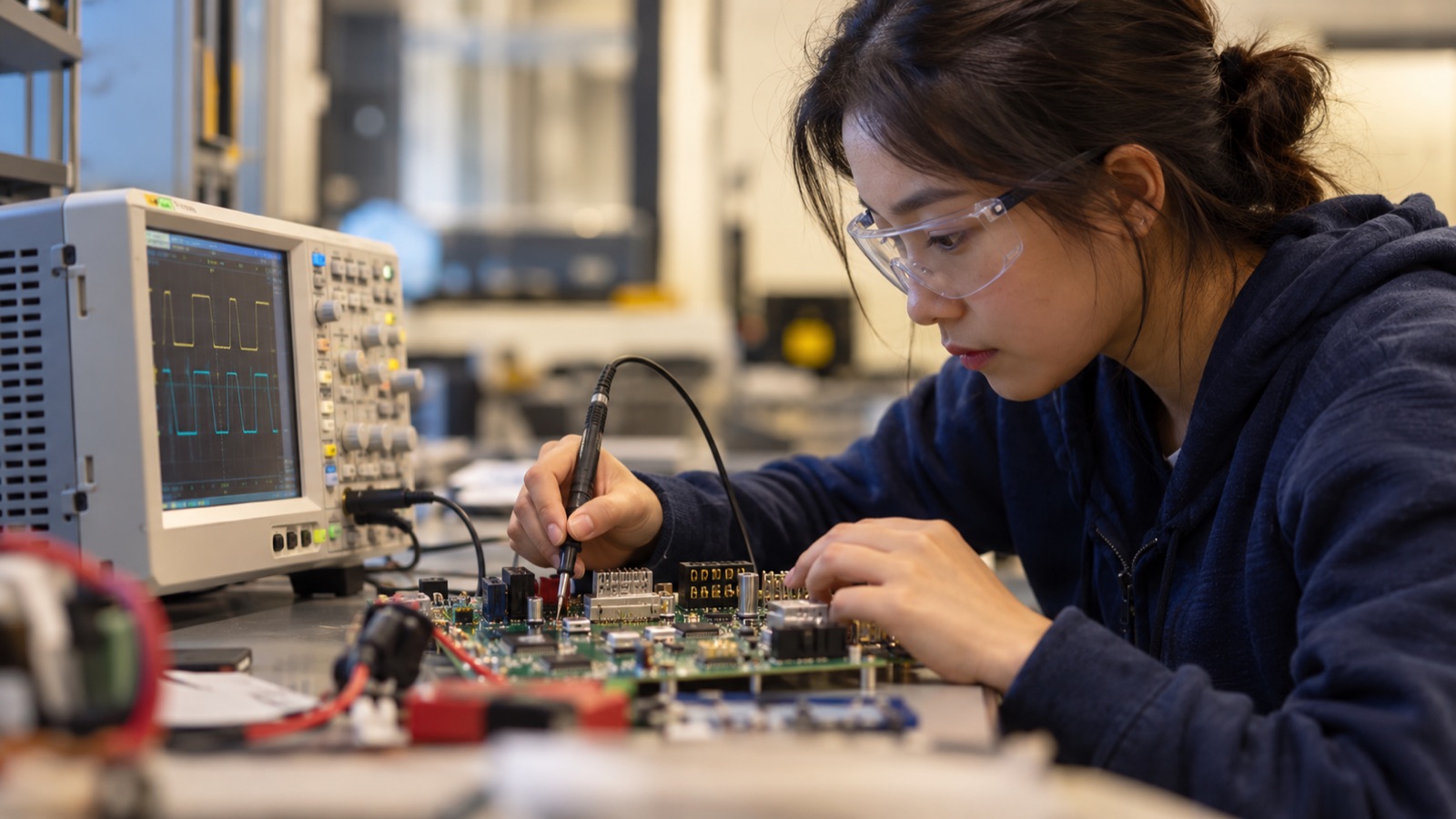
Ask how students move from concepts to practical work. Laboratories need to allow measurement, comparison and understanding of differences between model and observation. Look at equipment access, supervision and the role of technical writing. A report needs to explain method, results and limitations, rather than only present a photograph of the setup.
Practical activities need to remain within the institution's safe arrangements. Ask about training and procedures before using equipment. Do not try to reproduce a risky setup alone because it seems simple in a video. Choosing working conditions and recognising limitations are part of professional competence.
For design projects, look at constraints studied: performance, cost, reliability, use and maintenance. A solution needs to meet a defined need and be assessable. Ask how students justify choices and how individual contributions are observed in group projects.
Understand trade-offs through a fictional project
Imagine a student sensor project to monitor a room's temperature. A first team focuses on measurement accuracy. It then needs to examine operating autonomy, data transmission, cost and ease of installation. Improving one criterion can complicate another. Design work involves making these trade-offs explicit.
The project also needs to plan verification: which conditions to test, how to compare measurements and how to detect failure? A prototype working during a demonstration does not yet prove long-term reliability. Students can define an appropriate educational protocol, document results and suggest improvements without claiming to have created a product ready for commercial sale.
This type of exercise helps you judge your interest in the field. Do you enjoy connecting an idea, model, measurement and decision? Look for a program developing this chain of reasoning, with progression towards more complex projects and feedback on decision quality.
Choose a direction and prepare experiences
Options may bring you closer to energy, telecommunications, electronics, automation or other fields. Compare advanced courses and their prerequisites. Ask when the direction is chosen and whether courses are offered annually. A desired option needs to fit your actual calendar.
For placements, check selection, support and the experience's role in the qualification. International students' conditions for working and staying need checking in current official sources. Do not build your budget around unconfirmed pay.
If research appeals to you, ask about supervised projects and expected skills. A laboratory may introduce you to an open question and a specialised method. Ask what you will actually do and how this experience prepares further study. A team's general reputation does not replace a match with your interests and level.
Prepare a coherent application and budget
Your application needs to demonstrate required prerequisites and language proficiency. If you come from another system, prepare descriptions useful for assessment. For credit recognition, request a specific decision and its effect on progression. Recognised courses may lighten the workload without shortening the overall duration as much as expected.
Add personal equipment, software, travel and project periods to the budget. Ask what is provided before buying. Finally, keep authorised work you can explain: need, model, choices, trials and limitations. This portfolio will show your progression and help connect the qualification with a carefully prepared professional or scientific next step.
To compare two directions, ask for a final project example in each. Look at the problem addressed, tools, measurements and expected type of decision. A direction may attract you through its visible application, while everyday work relies mainly on models or trials you know little about. This reading lets you choose with a more accurate picture of the pathway. It will also help prepare complementary skills, such as technical writing or programming, supporting projects without always appearing prominently in their presentation.