

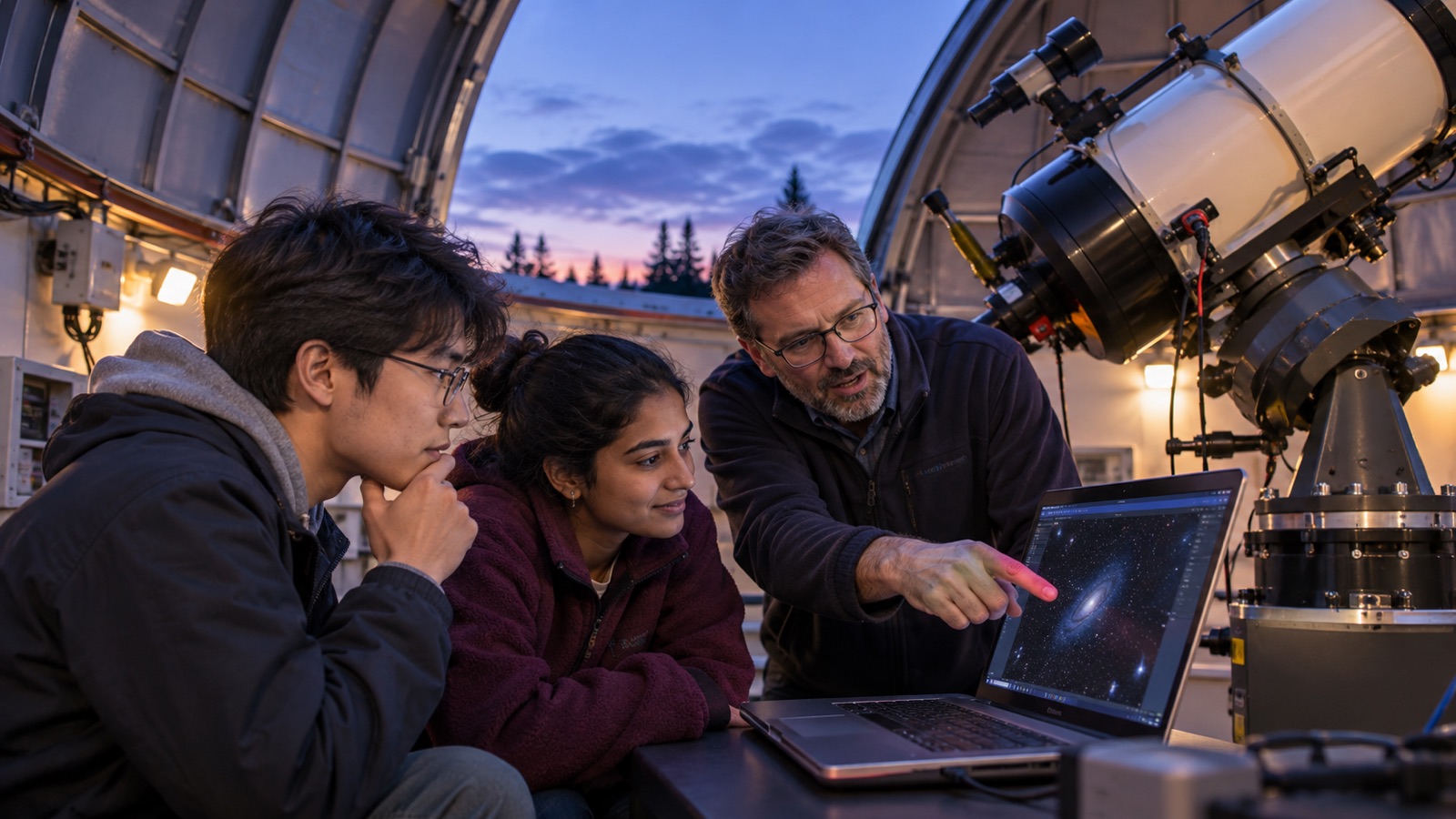
What role do physics, mathematics and computer science play?
The first question is not just “which celestial objects will I study?” but also “what tools will I learn to use to understand them?” At the University of Toronto, the programs examined draw on mathematics, physics and programming from the first year. The advanced Astronomy and Physics program then combines in-depth scientific training with supervised research.
An Honors worksheet from the University of Alberta illustrates this connection: it includes stellar and galactic astrophysics, computational physics and a PHYS 499 project. This document is dated August 7, 2024: it sheds light on the program structure, but does not certify the requirements for a later cohort.
To assess a program, therefore, examine the progression of courses rather than just whether they are listed. What role does mathematics play? When does programming begin? How do courses lead to scientific work? If you are still deciding between physics and astrophysics, these questions let you compare programs without committing too early to a particular title.
Universities and programs
The three institutions below offer distinct points of comparison. However, the presence of a program in the calendar is not enough to establish your admission requirements or whether applications are open for a particular intake.
| Institution | Focus to compare | Key point to examine |
|---|---|---|
| University of Toronto, St. George campus | Astronomy and Astrophysics Major or a Specialist program combining astronomy and physics | The depth of physics training and the place of supervised research |
| The University of British Columbia, Vancouver campus | Astronomy Major or Combined Honours program | Preparation for graduate studies and research |
| University of Alberta | BSc Honors in Astrophysics or BSc with a major | Program requirements and how courses connect with a scientific project |
Toronto: comparing the Major and Specialist programs
The StudyCanada profile for the University of Toronto provides an overview of the institution. At St. George, programs include Astronomy & Astrophysics Major (Science Program) and Astronomy & Physics Specialist (Science Program). The latter offers more in-depth physics and includes supervised research. Compare the required courses and the place of the project before choosing. This information concerns St. George and should not be applied to the Scarborough campus. At St. George, the two programs mentioned have open enrolment after students earn 4.0 university credits; this step is separate from initial admission to the university.
UBC: a clearly presented research focus
The StudyCanada profile for UBC provides a second point of reference. In Vancouver, the university presents astronomy studies as part of a four-year Bachelor of Science, an indicative duration that may vary depending on the course of study. UBC particularly recommends Combined Honours in Physics and Astronomy for students considering graduate studies and research. This recommendation is not a guarantee of subsequent admission.
Alberta: comparing Honors and the major
The StudyCanada profile for the University of Alberta offers a third reference. The University of Alberta offers a BSc Honors in Astrophysics as well as a BSc with a major in astrophysics. To compare them, ask about the requirements that apply to your cohort and the precise role of the research project: the 2024 worksheet does not replace the calendar for the year you are targeting.
Observatories: distinguishing the scientific environment from student access
Canada’s research environment extends beyond the equipment located on campuses. The National Research Council Canada’s Herzberg Astronomy and Astrophysics Research Centre operates observatories, supports international infrastructure, and develops instruments as well as data-processing and management tools.
CHIME offers a concrete example. This radio telescope is located at the Dominion Radio Astrophysical Observatory near Penticton, British Columbia. It should be distinguished from CHIME/FRB, the project dedicated to searching for fast radio bursts. The CHIME/FRB Collaboration brings together astronomers, engineers and students, with participation from UBC and the University of Toronto.
Institutional participation does not guarantee an internship or observing time. To compare two universities, instead ask how their students join projects: through a course, supervised work or an application to a team. For your decision, look for a concrete connection between the program and the infrastructure, rather than simply the presence of a telescope’s name on a page.
How can you explore research as an undergraduate?
A project is easier to assess when you know what the student actually does. At the University of Alberta, Professor Craig Heinke describes undergraduate projects that use telescope data. His profile asks interested students to specify, among other things, their programming experience and notes that supervision capacity is limited. This is an individual example, not a place offer that applies across the department.
To prepare to get in touch, describe your relevant courses, computing experience and the scientific question that interests you. Then ask what work might be possible at your level and what supervision would be provided.
Three questions can help distinguish a concrete opportunity from a general description:
- Which skills do you need to have already mastered?
- What is the expected outcome: data analysis, code, a report or a presentation?
- How are supervision and assessment organized?
CHIME/FRB also publishes catalogues. Exploring public data can help you reflect on the discipline, but it is not equivalent to supervised research experience.
Master’s and doctoral studies: verifying which pathways are actually open
At the graduate level, distinguish between a degree listed in the calendar and a pathway that is actually open to applications. The University of Toronto provides an important example: its 2026-2027 calendar lists a master’s and a PhD in Astronomy and Astrophysics, while the department’s page announces a pause in recruitment to the four-year doctoral pathway for the 2027 cycle and recruitment to the direct-entry PhD. Ask the department to confirm the pathway and application timeline for your intake.
The department indicates that a strong background in physics and mathematics can prepare students for direct entry. A degree with the exact word “astrophysics” in its title is therefore not the only preparation that may be considered. The university makes the assessment; no equivalency or automatic admission follows from this.
Before preparing your application, verify the open pathway, expected coursework and research teams’ topics together. Funding described on a general page does not, by itself, prove that a pathway is recruiting for your desired intake.
Budget and funding: comparing like-for-like amounts
An undergraduate tuition rate, doctoral funding and proof of resources for immigration address three different questions. They should not be used as though they all represented the actual cost of a year.
| Official reference | Amount or duration | Limit of comparison |
|---|---|---|
| UBC, Science, new international students covered by the 2026-2027 rate schedule | CAD 1,769.40 per credit, or CAD 53,082 for 30 credits | Tuition only; neither a full budget nor the 2027-2028 rate |
| University of Toronto, direct-entry PhD | Five years of funding announced | Read the conditions in the offer; does not apply to all institutions |
| University of Toronto, doctoral pathway after an MSc | Four years of funding announced | Does not prove that this pathway will be open to recruitment in 2027 |
The UBC amount above applies to international students covered by this rate schedule, not Canadian students. Nor is it a national rate.
At the University of Toronto, doctoral funding combines different resources; some external scholarships replace part of the institutional funding rather than being added to it in full. To compare an offer, ask for the total amount, any fees you still have to pay, teaching or research assistantship obligations, and the duration of funding. Prepare separate estimates for housing, food, transportation and other personal expenses.
International students: separating admission from a study permit
Immigration procedures are separate from university admission. According to information from IRCC consulted on October 26, 2026, a study permit application includes, among other things, proof of admission, identity documents and proof of financial resources. A provincial or territorial attestation letter may also be required, depending on the applicable requirements and exemptions.
For applications submitted on or after September 1, 2026, IRCC indicates that, outside Quebec, annual living expenses of CAD 23,448 for one person are required, in addition to tuition and transportation. This is a financial proof threshold, not an estimate of the actual cost in every city.
Do not add it a second time to a budget that already includes your living expenses: instead, compare your budget with the administrative requirement. This information concerns international applicants subject to these procedures, not Canadian students. It is general information, not individual immigration advice; consult the IRCC requirements applicable to your situation when preparing your application.
Building a shortlist that fits your plans
To narrow your list, start with what you want to explore during your studies, then look for the corresponding elements in the programs.
| Your priority | Key point to examine |
|---|---|
| Preparing to apply for graduate studies | Depth of physics and mathematics courses, supervised project, department recommendations |
| Exploring data-based work | Computing training and tasks offered in student projects |
| Joining an instrumentation environment | Concrete connection between teams, infrastructure and student opportunities |
| Comparing two offers | Cohort requirements, fees that apply to your status and funding conditions |
You do not need to have already chosen your doctoral research topic. However, look for a clear progression between what you already know, the skills taught and a first scientific experience. Before submitting your application for admission, confirm the key points with the departments. You can then make your choice based on program content, potential supervision and a budget, rather than on the appeal of a specialized title alone.