

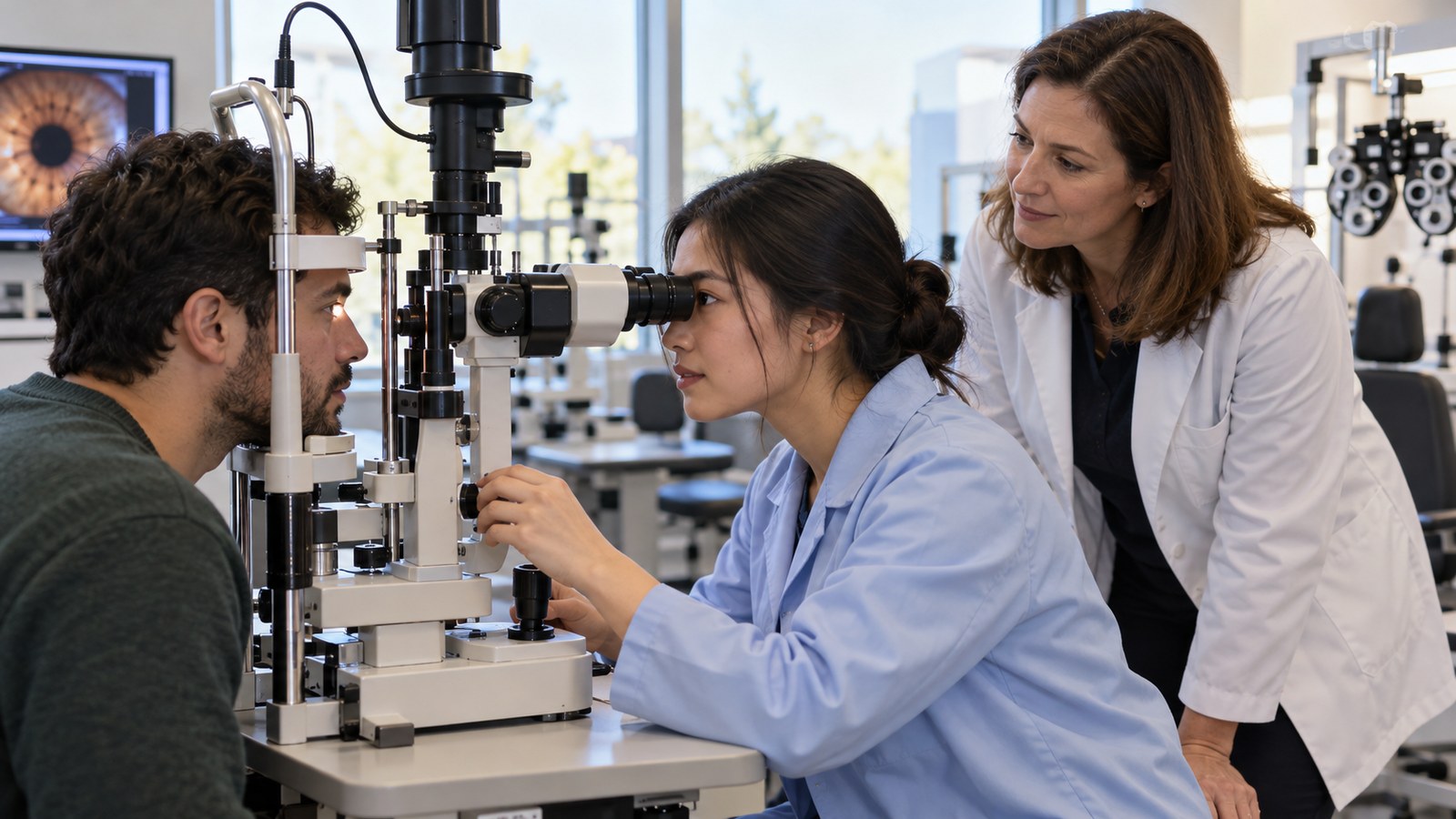
Three professions: choose the clinical field before the campus
Optometry focuses on vision and eye health; audiology, notably on hearing and vestibular function; and speech-language pathology, on speech, language, communication and swallowing. For students who are still undecided, the first choice is therefore about the assessments and interventions that interest them, before the city or campus.
The second choice concerns the purpose of the degree. A science program in communication is not necessarily an entry-to-practice program. UBC’s MSc in audiology includes clinical training, as does McGill’s professional MScA in speech-language pathology. Toronto also distinguishes its professional MHSc from research programs.
Do not rely solely on the word “master’s” or the level of the degree. For each pathway, examine its professional purpose, its placements and how it aligns with the requirements of the regulator in your intended province. A research doctorate should not be considered a shortcut to practice.
Optometry: two schools, two pathways to examine separately
The Canadian Association of Optometrists identifies two schools in Canada: Waterloo and Montréal. These limited options make it particularly important to review entry requirements in advance.
At Waterloo, the professional program lasts four years, following at least three years of university-level science studies. It is therefore not a direct-entry program after secondary school. In the general admission pathway, requirements include a minimum average of 75%, prerequisite courses, the OAT and Casper. Meeting the minimum does not guarantee admission; specific provisions exist for certain pathways.
At Montréal, the undergraduate doctorate in optometry consists of 197 credits over five years of full-time study. Eligible educational backgrounds and prerequisites are specific to this program. Simply comparing “four years” and “five years” would be misleading: the studies required before entry are not the same.
Status is another filter. Montréal requires Canadian citizenship or permanent residence by the deadline. Waterloo lists a requirement for Canadian citizenship or legal residence in Canada for at least twelve months before first enrolment, with a limited international option for particular circumstances. This exception is not a regular international admission pathway: ask the institution to clarify your eligibility before incurring expenses.
Does your status allow you to apply?
A university may welcome international students without opening all its clinical programs to them. Check this before preparing for tests or having your courses assessed.
| Program | Documented status requirement |
|---|---|
| Optometry at Montréal | Canadian citizenship or permanent residence by the deadline |
| Optometry at Waterloo | Canadian citizenship or the legal residence requirement specified by the university; limited international option |
| UBC clinical MSc | Restricted to Canadian citizens and permanent residents |
| Audiology at Laval | An international category for study permit holders is provided, subject to applicable requirements and authorizations |
| Toronto MHSc in speech-language pathology | Canadian citizenship or permanent residence required at the time of application; international students not admitted |
| McGill professional MScA in speech-language pathology, fall 2027 | Applications from non-Canadians not residing in Canada on January 15, 2027, are not accepted; specific authorization must be requested by affected individuals residing in Canada |
A foreign degree and international status are not synonymous. Toronto provides for the assessment of degrees earned abroad for individuals who hold the required status. Conversely, having studied in Canada is not enough to meet a citizenship or permanent residence requirement.
At McGill, affected non-Canadians residing in Canada on January 15, 2027, must request specific authorization from the school and provide proof of residence. This authorization to apply does not constitute admission. The school links the restriction to the background checks required for placements.
At Laval, a distinction must be made between regular admission to audiology and supplementary training for already-qualified professionals under the program for entry into professional orders: admissions to the latter are temporarily suspended. The international status provision indicated here must not automatically be extended to speech-language pathology.
Universities and programs
The following four examples illustrate distinct pathways. They are neither a ranking nor a list of programs accessible to applicants of every status.
- The University of British Columbia — The Master of Science in Audiology and Speech Sciences, Sub-Specialization in Audiology (MSc) lasts two years and combines scientific training with clinical placements. The restriction to Canadian citizens and permanent residents is decisive.
- Université Laval — The Maîtrise en orthophonie consists of 76 credits, with a full-time schedule planned over two years and six terms. The institution’s audiology pathway also follows this general structure, although the prerequisites for the two disciplines are not identical.
- McGill University — The Communication Sciences and Disorders (Non-Thesis): Speech-Language Pathology (M.Sc.A.) is an 82-credit professional program over two years. It must be distinguished from thesis-based programs and research doctorates, and the application restrictions announced for 2027 must be taken into account.
- University of Toronto — Speech-Language Pathology, leading to the MHSc, is a professional pathway. Its FAQ distinguishes this program from research opportunities and specifies that it does not accept international students.
A program’s presence in a calendar confirms its existence, not your eligibility. The requirements for the intended admission cycle remain decisive.
Prerequisites and languages: look beyond the average
At Laval, the master’s programs in audiology and speech-language pathology require a bachelor’s degree or equivalent, prerequisite courses and, in the general admission pathway, a minimum average of 3.3 out of 4.33. Specific provisions are listed for members of First Nations and Inuit in Quebec. This threshold does not provide an automatic conversion of foreign grades.
Prepare a table linking each prerequisite to a course you have already taken, along with its detailed description. Similarity between two course titles is not enough to establish equivalency. UBC’s announcement for 2027 also sets a specific deadline for the assessment of syllabi that are not already listed.
Clinical language requirements deserve a separate check from the language of instruction. At Laval, both master’s programs require the SEL-B with at least 75% in each of the two parts; other proof of French proficiency may also be required depending on your language background. Their testing schedules should not be assumed to be identical.
At McGill, courses are taught in English. Some placements require French-English bilingualism, but English-language placements allow students to fulfil the degree’s practical requirements. Bilingualism therefore broadens the range of available settings without being a uniform requirement for all placements.
2027 entry: build your timeline in the right order
The following dates were announced by the institutions and verified on October 26, 2026.
| Pathway | Announced deadline or change |
|---|---|
| Optometry at Montréal, fall 2027 | Apply by November 1, 2026, for applicants who have studied at university or outside Quebec; by March 1, 2027, for those with only Quebec college studies |
| Optometry at Waterloo, September 2027 | OAT must be taken between August 31, 2024, and September 30, 2026, inclusive: this deadline has already passed as of October 26, 2026 |
| Optometry at Waterloo, September 2027 | New requirement concerning a full course load in the majority of terms completed |
| UBC MSc, September 2027 | Portal opens November 1, 2026; unlisted syllabi must be submitted by December 1, 2026; application due by February 1, 2027 |
| McGill professional MScA, fall 2027 | Applications close January 15, 2027; residence in Canada on that same date is decisive for the affected non-Canadian applicants |
Start with the elements that determine whether your application can be considered: status, test validity and prerequisites. Then add the deadlines for the other documents. An application deadline does not mean that all tests can be taken up to that date.
Budget and placements: consider the entire pathway
A generic annual fee is not enough to estimate the cost of a clinical program. At Laval, tuition depends in particular on the student’s profile and the number of credits registered. The service distinguishes several categories, including those for French and French-speaking Belgian students: nationality should therefore not be reduced to a simple distinction between Canadians and international students.
Request an estimate corresponding to your intended program and study plan. To build your budget, include items to be confirmed for tests, documents, housing, travel to placements and professional registration procedures, rather than assuming these expenses are identical everywhere.
For international students who are indeed eligible for their program, IRCC states that, since April 1, 2026, the post-secondary placements covered by the rules no longer require a co-op work permit, subject to conditions. These conditions concern, in particular, the work conditions printed on the initial study permit and a letter from the institution confirming the mandatory placement. IRCC also provides for cases where an extension is requested before the permit expires and an exception to full-time study in the final term. Placements remain limited to 50% of the program. Consult the official page for the complete conditions.
For a hospital placement or a placement in certain other settings where public health must be protected, IRCC also requires a medical examination, unless one has already been completed.
This federal rule does not remove university admission restrictions. This general information, verified on October 26, 2026, does not constitute individual immigration advice. The official IRCC page is listed in the bibliography.
After graduation: accreditation, certification and professional registration
These three concepts are not interchangeable.
| Concept | What it concerns |
|---|---|
| Accreditation | The assessment of a program; the Canadian accreditation council publishes a directory of audiology and speech-language pathology programs and their statuses |
| Professional registration | The individual steps required by the competent regulator to practise in the province concerned |
| Speech-Language & Audiology Canada certification | Voluntary certification that does not replace provincial authorization to practise |
In Quebec, the graduates concerned in audiology and speech-language pathology must complete the procedures for a permit and entry on the OOAQ’s roll. In Ontario, these procedures fall under CASLPO. The precise obligations depend on the pathway: a single national examination mandatory for everyone must not be assumed to exist.
Optometry graduates from Montréal must also complete the permit and registration procedures with their Quebec professional order, including the applicable professional liability insurance requirements. The degree does not exempt them from these formalities.
To distinguish between your options, follow this order: choose the profession, identify the clinical degree, check your status, compare prerequisites and placements, then examine the regulator’s requirements. A program is a realistic option only if these different steps fit your circumstances.