

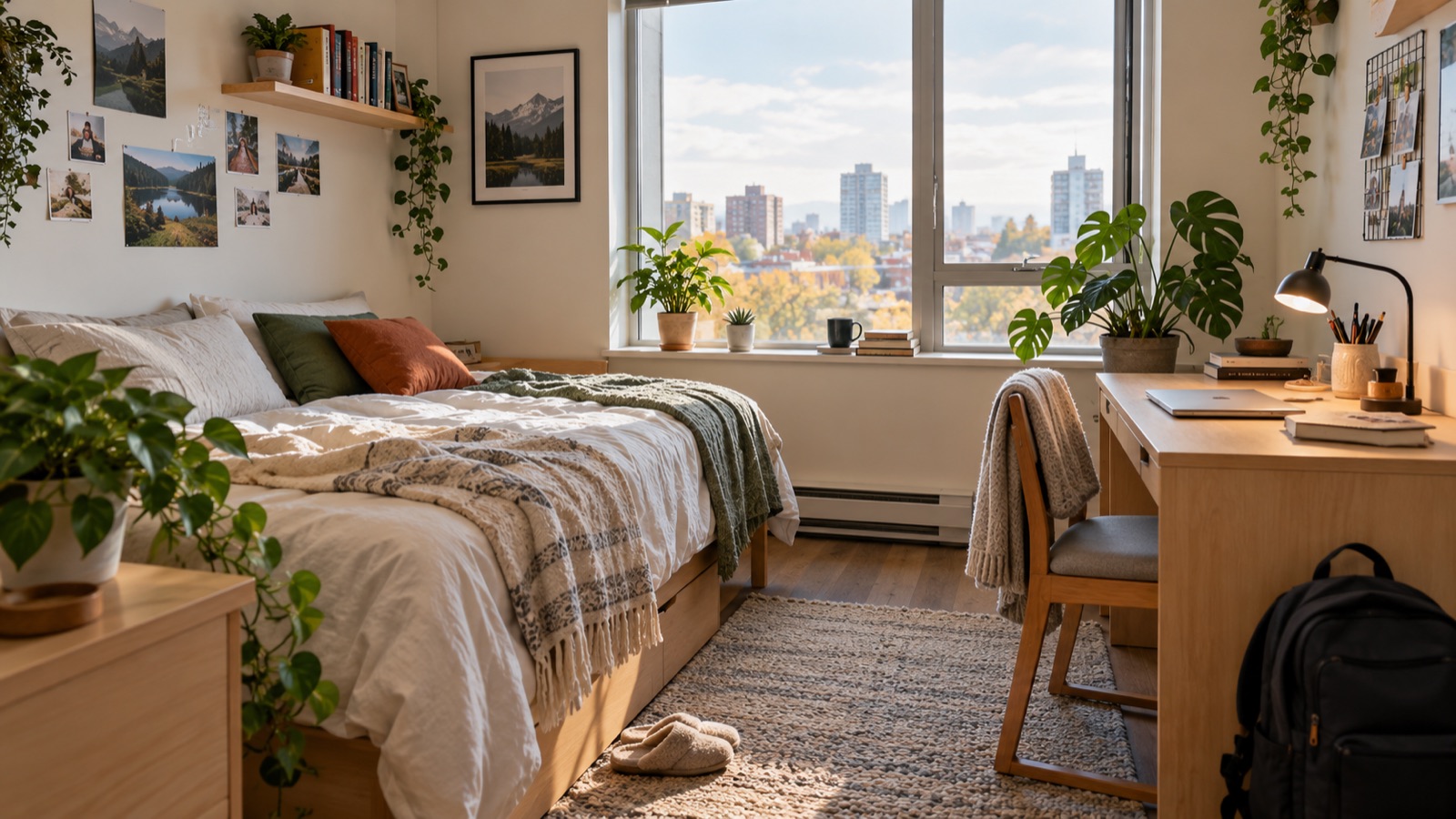
Before the viewing: set your own criteria
A room may be in a house, apartment or condominium, with shared spaces. The questions below can help you compare these arrangements without assuming that they all offer the same conditions.
Review the listing and note the address, the stated price and what appears to be included. Bring your phone, something to write with and, if you wish, a measuring tape. Also set your priorities: working in peace and quiet, storing equipment, easy access to the bathroom or getting to your institution at a specific time.
Ask the same questions at every viewing. For important answers, distinguish between what you have observed, what you have been promised and what still needs to be confirmed in writing.
In the room: imagine an ordinary day
Take a few minutes to look beyond the furnishings. If you study in your room, try to imagine where you will set up your belongings and computer.
- Furniture and storage: Which pieces of furniture will stay? Is there enough room for your clothes, suitcase and study materials? Measure the space if the size of a piece of furniture matters to you.
- Light and windows: Does the window open and close? How much light comes into the room?
- Comfort: Where are the electrical outlets? How is the heating controlled?
- Condition: Look at the walls, ceiling and area around the window. Are there any visible signs of dampness or mould? If you notice a problem, ask how and when it will be addressed.
- Noise: Listen for sounds from the street and the home. Ask what changes in the evening or when the other occupants are there.
A viewing at only one time of day does not establish that the room will always be quiet. If quiet is essential for you, ask whether you can come back at another time.
Access and safety: follow your actual route
Try the route you would take every day, from the entrance to the room and shared spaces. If you have an accessibility need, check the pathways and features that matter to you yourself, rather than relying only on a general description.
Ask: “Who has the keys? How do you get into the building and the room? What happens if a key is lost or a lock does not work properly?” Look at the room’s door and lock.
Also locate the exits and detectors. Ask how to report a problem and who responds. The presence of a detector alone does not prove that it works or that the home meets all local requirements.
Shared spaces: ask about everyday life
Whether a room suits you may also depend on how the kitchen, bathroom and laundry are used. With the permission of the person showing you around, try the taps and included appliances.
| What to check | Questions to ask |
|---|---|
| Kitchen and bathroom | How many people share them? Are there schedules or rules for using them? |
| Storage | Where can I store my food and personal belongings? |
| Maintenance | How is cleaning organized? Who should I tell if an appliance is faulty? |
| Laundry | Where are the machines, and is there a fee to use them? |
| Shared living | What are the rules about guests, noise and shared spaces? |
Ask to see the applicable rules, especially if an answer is important to your study routine. A good impression of the room does not necessarily answer your questions about shared living.
Before signing: what terms should you request in writing?
Ask for the agreement and any appendices, then take the time to read them. Clarify whom you are entering into the agreement with: the owner, a property manager or someone who is already a tenant. The name and role of your contact matter when you need to know whom to direct your questions to.
In particular, check:
- the rent, how often it is due and the payment arrangements;
- included services and any possible extra expenses, such as electricity, Internet or laundry;
- the move-in date, the length of the agreement and the conditions for leaving;
- any deposit requested, its purpose and the conditions for its return;
- responsibilities for maintenance and repairs;
- promised work, its deadline and the person to contact.
If you are promised that a window will be repaired or that a piece of furniture will be provided, ask for that commitment to be confirmed in writing. However, a written clause is not automatically valid: check the applicable rules before concluding that the proposed terms are allowed.
Remote viewings and warning signs
If you cannot be there in person, ask for a live video viewing: have the entrance, room and shared spaces shown, then ask the same questions you would in person. If possible, someone you trust can also view the room for you. However, a video does not guarantee that the listing is genuine.
A request for a deposit without an agreement, inconsistent photos or pressure to pay quickly are warning signs, but do not by themselves prove fraud. Check the address, images and the identity of your contact. Do not let yourself be pressured into sending money; before providing sensitive documents, verify the recipient and whether they need them.
If you are a victim of fraud, contact the local police and also report the case to the Canadian Anti-Fraud Centre.
After the viewing: compare and check local rules
For each room, summarize the known total cost, your planned commute, your observations and any answers you are still waiting for. A simple table can help:
| Criterion | Room A | Room B |
|---|---|---|
| Confirmed rent and additional fees | To be filled in | To be filled in |
| Commute to the institution | To be filled in | To be filled in |
| Quiet, storage and access | To be filled in | To be filled in |
| Written terms received | Yes / no | Yes / no |
| Issues or promises to clarify | To be filled in | To be filled in |
In Canada, residential tenancy rules vary by province or territory. Also check the rules that apply to your specific arrangement: do not assume that a room, a residence and an entire home necessarily fall under the same set of rules. If in doubt, contact the relevant local authority or your institution’s housing service.
When you move in, document the condition of the premises and keep the agreement, correspondence and receipts. This will give you a useful record if a question comes up later.