

Start with what interests you
Imagine three situations: helping care for an animal, observing its behaviour from a distance or thinking about the needs of animals on a farm. Which one makes you curious? You can choose more than one, or you may not know yet.
| What interests you | A path to explore | A question to ask yourself |
|---|---|---|
| Taking part in animal care and learning precise techniques | Animal health technology | Am I also interested in science and assisting other people? |
| Observing animals and understanding their behaviour | Wildlife and biology | Would I like to take notes and look for explanations, even without direct contact? |
| Understanding the needs of farm animals | Animal production and agricultural studies | Am I also interested in nutrition and how a farm is organized? |
This table is neither a ranking nor a complete list. It helps distinguish between the activity, the setting and the program. The same curiosity about animals can lead in several directions.
Taking part in animal care: animal health technology
If you would like to be close to animals and contribute to their care, animal health technology is a path distinct from veterinary medicine studies. It can prepare you to assist in a clinic or with research staff.
For example, in Quebec, a college program offered by Cégep de Sherbrooke includes cell biology and handling small vertebrates. The institution also describes care for small and large animals, as well as assistance in clinical and research settings. This example does not describe every program or the procedures permitted in each province or territory.
When considering this path, think about more than just being around animals. Ask yourself whether you are also interested in learning scientific concepts, practising precise techniques and working as part of a team. If you are considering a specific role later on, check the requirements that apply where you want to work.
Observing and understanding: a path in wildlife
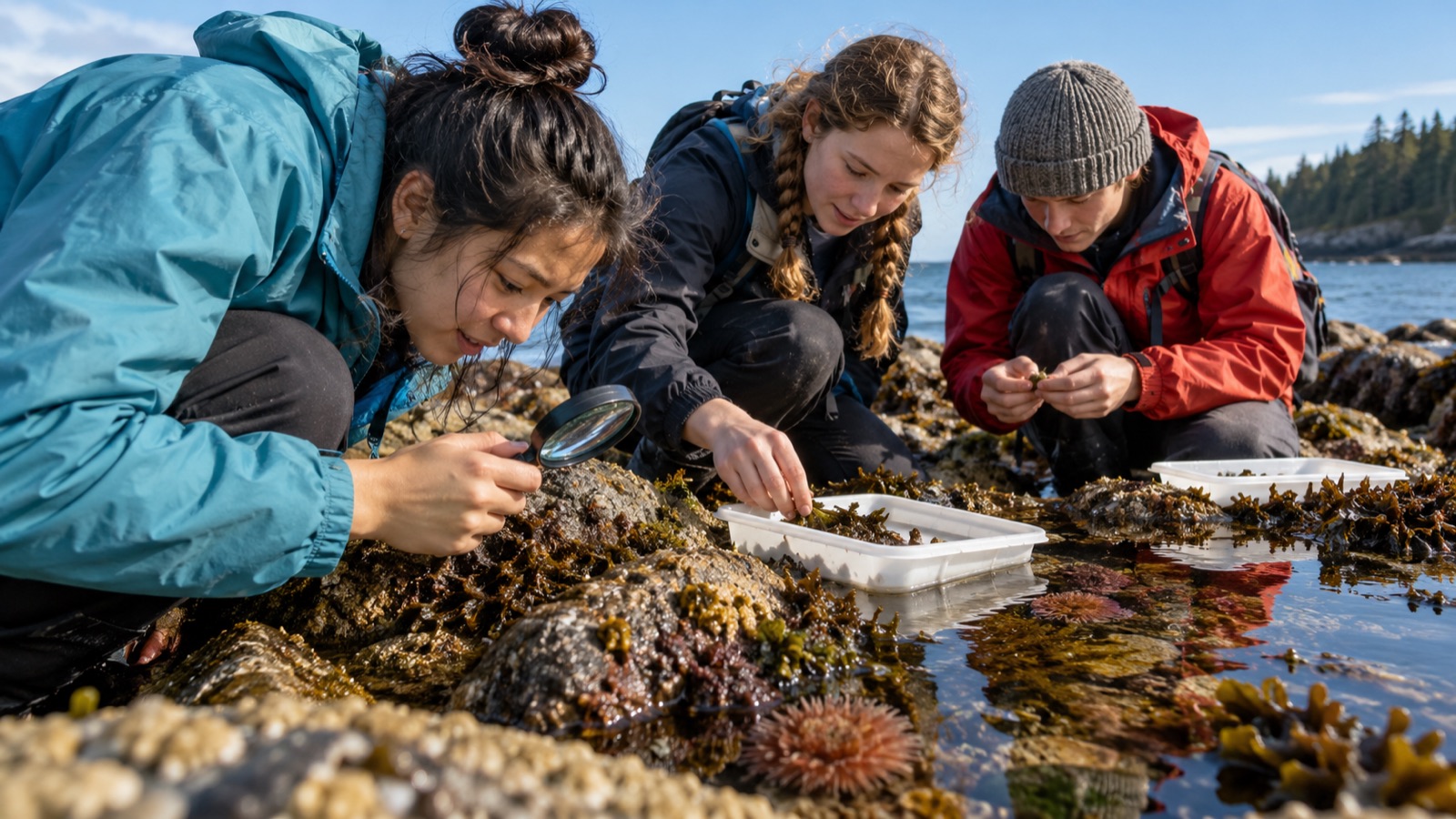
You may be more intrigued by a question like “Why is this animal behaving this way?” than by the idea of taking part in animal care. Biology can let you explore animals, their populations and their habitats.
One Quebec university example, presented by Université Laval, covers population monitoring and behaviour in an animal ecology concentration. Its description also refers to measurement, sampling and fieldwork. This does not mean that every biology program devotes the same amount of time to fieldwork, or that everyone who studies wildlife works in daily contact with animals.
You can start with a short exercise: write down what you see, then separate your observation from your hypothesis. A bird carrying a branch is an observation; the idea that it is building a nest is one possible explanation.
Observe wild animals from a safe distance, do not feed them and check the site’s guidelines before your visit. Parks Canada encourages visitors to learn about their destination and give wildlife space; check the guidelines for the specific place you visit.
Understanding the needs of farm animals
Agriculture offers another way in if you like thinking about animals’ needs, as well as decisions about their living environment. What would you be interested in learning about their nutrition, health or well-being?
In Quebec, a college specialization in animal production offered by Cégep de Sherbrooke brings together these topics with reproduction and farm management. It also includes courses related to accounting and agricultural equipment.
So the question to ask yourself is broader than “Do I like farm animals?”: would I also want to understand how an agricultural business is organized? This example illustrates one possible combination; it does not represent every agricultural program in Canada.
Comparing programs in Canada
Once two paths have caught your attention, look at what you would actually learn. The examples above are from Quebec institutions: they show a technical program in animal health, an agricultural pathway and university studies in biology. They do not mean that courses or requirements are the same elsewhere in Canada.
To compare two programs, look for the following information from each institution:
- Courses and methods: How much emphasis is placed on science, handling, fieldwork or management?
- Contact with animals: What activities are described, and which species are studied?
- Practical experience: Are there placements or other supervised activities? Are they mandatory?
- Admission: What prerequisites and documents are required for your educational background?
- Day-to-day experience: Where does the program take place, and in what language?
If you studied outside Canada, ask the institution how it assesses your educational background and what requirements apply to your situation. If you are already studying in Canada, check the prerequisites for your own educational background. In both cases, consult the requirements for the program and jurisdiction you are considering.
A program can help you pursue your interests without guaranteeing admission, a job or access to every role.
A small step to test your interests
You do not need to choose a career now. On your own or with someone you trust, you can take a few steps:
- Keep a journal. Write down what you observe from a distance and the questions it makes you want to ask.
- Talk to someone in the field. What do they enjoy about their activities? Which tasks surprised them? What place do animals have in their day?
- Look for a supervised activity. Your school may be able to help you discover a field. Before taking part in any activity with an organization, ask about its age, authorization and safety requirements.
- Compare two paths and two course lists. For each path, note one activity that appeals to you, one that makes you hesitate and one question to ask an institution.
You may discover that you would rather observe animals than take part in their care, or that you are interested in livestock farming as much for the organizational decisions as for the animals themselves. The goal is not to find the perfect career right away, but to better understand what makes you want to learn.