

From the KCSE to admission: what is the equivalency?
The Kenya Certificate of Secondary Education, or KCSE, can serve as the basis for an undergraduate application. For someone applying from secondary school, the University of Ottawa indicates a minimum average of 75%, in addition to the program’s prerequisite subjects. Some requirements may be higher, and meeting the minimum does not guarantee admission.
This figure is specific to Ottawa: it is not a conversion scale that applies to all Canadian universities. If you followed a different curriculum, look for the requirements that correspond to your academic background. For any other Kenyan school system, ask the institution how it will assess your documents, without assuming that it will apply the KCSE scale.
For a master’s degree, Ottawa’s Kenya section on international equivalencies lists a bachelor’s degree or professional qualification and the minimum “2nd Class Hon., Upper Division; 60%”. This is also an institutional reference point: the program may have other requirements, and no degree automatically creates an equivalency that applies across Canada.
What academic documents should you gather?
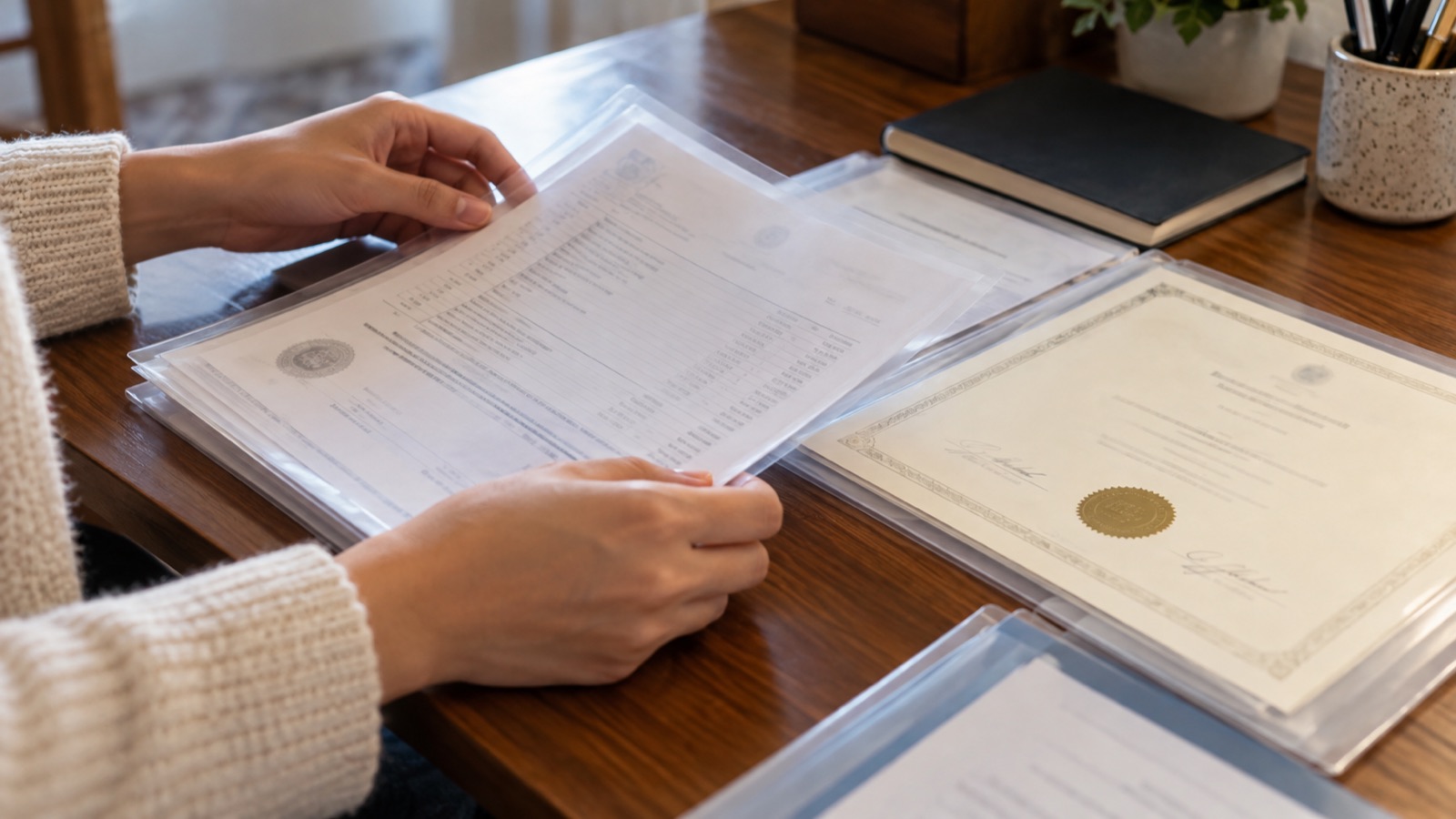
The list varies according to how far along you are in your studies. The following example is for undergraduate applications to the University of Ottawa:
| Situation | Academic documents listed by Ottawa |
|---|---|
| KCSE in progress | Transcripts from the previous three years and first-term results for the final year |
| KCSE completed | KCSE results and proof of the credential |
| Post-secondary studies started or completed | KCSE results, proof of the credential and post-secondary transcripts |
For another university, check its own list, format and submission method. If your final results are not yet available, ask which interim documents may be considered.
Prepare a second list for the study permit. Documents submitted to the university do not necessarily replace those requested by immigration authorities. The Nairobi visa office’s additional checklist includes translations for documents that are neither in French nor English: check the instructions that apply to your application as well as those of each institution.
English or French: do you need to take a test?
Having studied in Kenya does not automatically exempt you from providing proof of language proficiency. Before booking a test, compare the institution’s and program’s rules: accepted tests, required scores, validity period and possible exemptions.
For undergraduate studies, Ottawa includes Kenya among the countries covered by a possible English-test exemption after three years of full-time study, subject to conditions. These may be the final three years of secondary school or post-secondary studies in English. The institution attended must have used English as its sole language of instruction, except for language courses. Ottawa may still request a test.
McGill provides, among other options, an exemption after four consecutive years of residence and secondary or university studies in a country on its list, including Kenya. Its admissions office may also request proof of English proficiency. The two criteria are therefore not interchangeable. For a program in French, check separately which proofs and exemptions are accepted.
Study permits: general documents and the Nairobi checklist
A study permit application includes, among other things, a letter of acceptance from a designated learning institution, proof of identity and financial documents. A provincial attestation letter or territorial attestation letter is generally required, subject to exceptions.
Since January 1, 2026, one exemption applies to programs leading to a master’s or doctoral degree at a public designated learning institution. It does not automatically apply to all graduate certificates or diplomas. In Quebec, most people exempt from the federal attestation must still obtain a Quebec Acceptance Certificate, or CAQ, subject to applicable exceptions.
Read the general instructions from Immigration, Refugees and Citizenship Canada, or IRCC, together with the instructions associated with your application. The Nairobi visa office’s additional checklist, IMM 5839 F, in its February 2026 version, includes:
- a one-page study plan;
- a CV if the person has not been studying full-time for at least two years;
- consent to bank verification;
- applicable supporting documents if a third party is financing the studies.
This list is not exhaustive. Consult the current version and the documents requested for your situation.
Proof of funds: distinguish the thresholds from your total budget
The required living-expense amount is only one part of the funding you need to plan for. For a single person, the reference amounts consulted are as follows:
| Destination and application date | Annual minimum | Expenses listed separately |
|---|---|---|
| Outside Quebec, from September 1, 2026 | 23,448 CAD for living expenses | Tuition and transportation |
| Quebec, from January 1, 2026 | 24,617 CAD for basic needs | Tuition and return transportation from the country of origin |
The first figure comes from IRCC’s general threshold; the second is a provincial threshold. Their scopes are not identical: in Quebec, basic needs include housing, local transportation, and health and hospitalization insurance, among other things. Amounts vary according to the number of people. Some specific streams also have their own financial rules: check the rules for your category, without assuming that your residence in Kenya alone determines your eligibility.
IRCC requires you to demonstrate that you have the resources needed for the first year and, for longer studies, explain how you will finance the rest. You must demonstrate financial capacity without relying on work in Canada. Depending on your situation, supporting documents may include bank statements, a loan, a scholarship or documents relating to family support. Check which documents are required for your application and document the source of the funds.
To prepare your budget, separate tuition, living expenses, transportation and other relevant costs. A scholarship that covers tuition alone does not, by itself, demonstrate that you can pay the remaining expenses.
Biometrics, medical exams and processing times: plan your timeline
If biometrics are required, follow IRCC’s instruction letter and book an appointment at an official collection location. The federal directory lists a visa application centre in Nairobi; check its services and hours before travelling.
At the time of consultation, the federal fees displayed were 150 CAD for a study permit and 85 CAD for individual biometrics, when required. Translation, medical exam or travel fees may also apply.
A medical exam may also be required. IRCC requires one, among other situations, for a planned stay in Canada of more than six months after at least six consecutive months of residence or travel in a country of concern during the year before arrival. Kenya is on this list. The criterion concerns stays and travel, not only nationality; other situations may also make an exam necessary.
For study permit processing, consult IRCC’s processing-time tool and select the relevant category and location. The result is an estimate, not a guaranteed decision date. In your timeline, keep the application deadlines, arrival of transcripts and any language-test results, attestations, study permit submission and biometrics as separate milestones.
Scholarships: short-term exchange or full degree?
Funding may be for temporary mobility rather than a full degree. This is the case with the Study in Canada Scholarships for the 2026-2027 call, which was for short-term study or research exchanges. Kenya was among the eligible citizenships.
For this call, conditions included citizenship of an eligible country, full-time enrolment at a post-secondary institution in an eligible country, and payment of fees to that institution at the time of application and throughout the mobility period. Studying in Kenya was therefore not enough to meet the citizenship criterion. Other exclusions applied. Canadian institutions submitted the applications; the institutional deadline of March 31, 2026 has passed. Ask your institution about any subsequent calls.
For an eligible master’s degree, McGill’s Mastercard Foundation Scholars Program is another option to follow. Kenya is on its list of countries, but the funding has several conditions. It excludes, among others, people who are already enrolled in or hold a master’s degree. McGill indicated that applications for the fall 2027 cohort were closed and invited interested people to consult its information in spring 2027.
In your financial plan, distinguish funding you are considering from a scholarship that has actually been awarded, then check which expenses it covers.
Universities and programs: compare before choosing
These two StudyCanada profiles can serve as starting points. They do not confirm that a particular program is open or indicate your chances of admission:
- University of Ottawa: its official page on Kenya details the KCSE, academic documents and undergraduate requirements.
- McGill University: its official information can help you compare English-language proof requirements and follow the Mastercard Foundation Scholars Program criteria.
For each program you are considering, note the required degree, prerequisite subjects, language, documents, dates and fees. You can then compare these requirements with your academic background and budget, and confirm the conditions directly with the institution. Applying, looking for a scholarship and applying for a study permit remain three separate processes.