

From the Ivorian Baccalaureate to a Canadian Degree
The word baccalaureate does not refer to the same level in both systems: the Ivorian baccalaureate marks the end of secondary school, while a Canadian bachelor’s degree is an undergraduate degree. To choose a program, start with the level you want to pursue, then review each institution’s prerequisites.
| Institution | Information for an Ivorian academic background | Limitation to keep in mind |
|---|---|---|
| University of Ottawa / Université d’Ottawa | The general secondary school baccalaureate is a basis for undergraduate assessment; the technical baccalaureate is not. | Program prerequisites and other requirements still apply. |
| Université Laval | The baccalaureate is listed among the minimum qualifications for undergraduate studies; the licence is listed among those indicated for a master’s degree. | Meeting the minimum qualification does not guarantee admission. |
Laval also indicates a requirement of 13 years of pre-university schooling for undergraduate studies. Depending on the application, qualifying courses may be required; they are available only for non-restricted programs.
This comparison is neither a ranking nor an automatic equivalency chart for all of Canada. If you have already undertaken postsecondary studies, also ask the institution how it assesses possible transfer credit: this is separate from admission.
Gather Academic Documents and Check Language Requirements
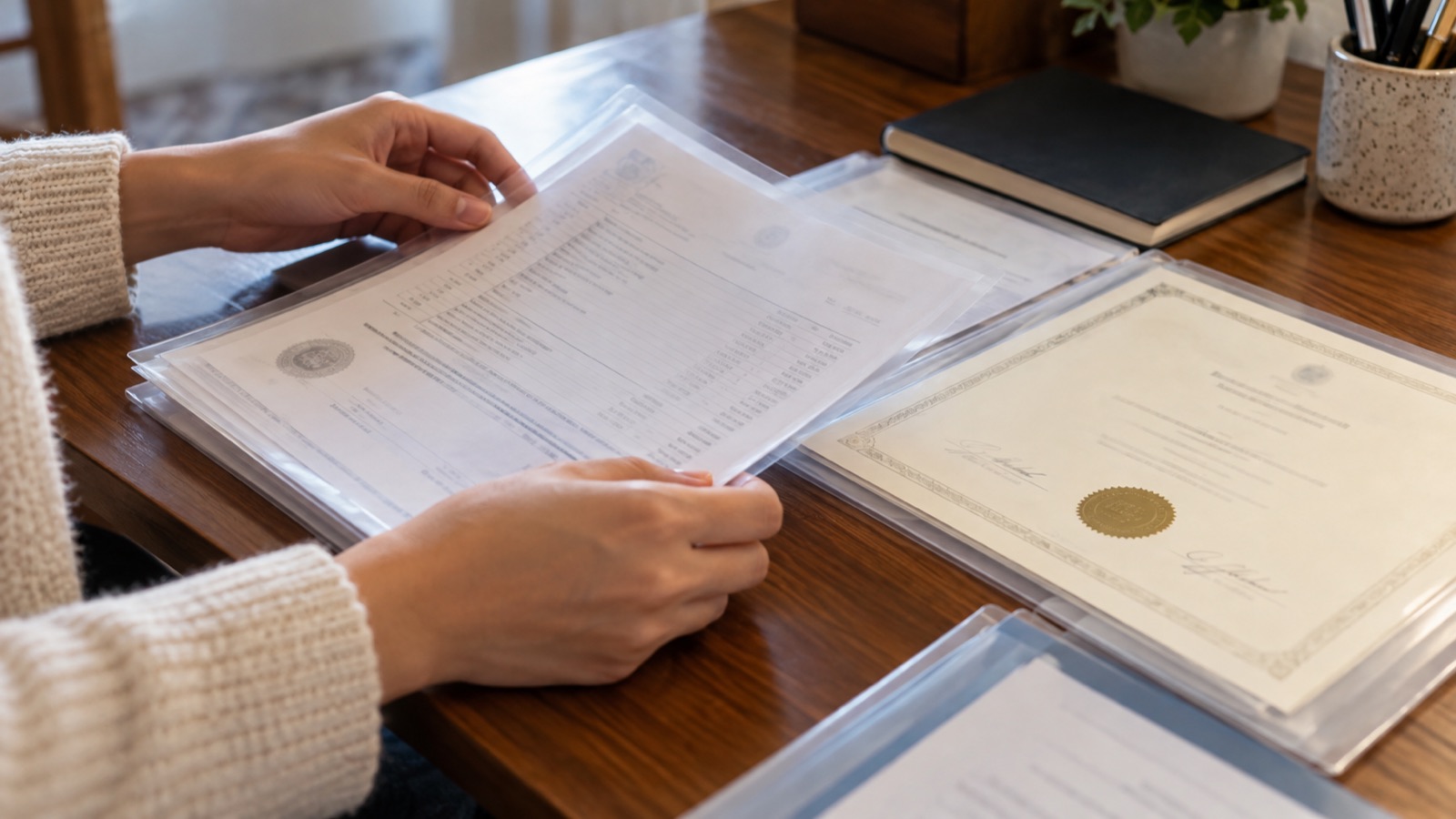
Documents depend on your academic background. At Ottawa, a student in their final year of secondary school provides, among other things, their Grade 11 report cards, results from the baccalaureate preliminary examination and first-term Grade 12 report cards. After completing the baccalaureate, the university requests, among other things, exam results and Grade 11 report cards. Applicants who have begun postsecondary studies must add the corresponding transcripts.
This list is specific to Ottawa. For another application, check the exact document, format and submission method with the receiving institution. In Côte d’Ivoire, the eRequests portal of the Directorate of Examinations and Competitions, or DECO, provides procedures relating to the baccalaureate diploma, transcripts and authentication. Authentication is not an admission decision.
For language requirements, Ivorian citizenship alone does not establish an exemption. For Ottawa undergraduate studies, an exemption from the French test may apply to a person who has studied full-time for three years under the conditions specified by the university. These years may include the final three years of secondary school or postsecondary studies in French; Côte d’Ivoire is among the locations listed. Ottawa may nevertheless request a test.
At Laval, consult the “Knowledge of French” page for the evidence applicable to your academic background. For a program taught in English, check the English-language requirements separately. Before booking an exam, check the accepted tests, required results and validity period.
Universities and Programs: Compare Before Applying
Two StudyCanada profiles are a place to start exploring institutions whose official information addresses Ivorian academic backgrounds:
- University of Ottawa, in Ontario: its page for Côte d’Ivoire distinguishes documents according to how far a student has progressed in their studies.
- Université Laval, in Quebec: its table presents minimum qualifications by level and pre-university schooling requirements.
These profiles are starting points, not a ranking or proof that a program is open. For each program you are considering, note the required credential, prerequisites, language, documents, fees and application deadline. Confirm these details on the institution’s official website before submitting your application.
From Admission to Study Authorizations
Prepare two separate lists: one for the university admission process and one for the authorities’ authorizations. A document requested by one does not necessarily replace a document required by the other.
A regular study permit application includes, among other things, a letter of acceptance from a designated learning institution, proof of identity and proof of financial resources. A provincial attestation letter or territorial attestation letter, known as a PAL or TAL, is also required in many cases, with some exceptions.
Since January 1, 2026, the PAL or TAL exemption applies, among other cases, to programs leading to a master’s or doctoral degree at a public designated learning institution. It does not apply indiscriminately to all graduate programs.
In Quebec, when a Quebec Acceptance Certificate, or CAQ, is required, its attestation of issuance bearing the required wording serves as a PAL or TAL in the applicable cases. Most people who are exempt from a PAL or TAL and are studying in Quebec must still obtain a CAQ, subject to exceptions. The CAQ does not replace the federal permit.
To find the applicable instructions, search IRCC’s “Apply to study in Canada – study permit” page and select Côte d’Ivoire. It links, among other things, to instructions IMM 5826. Read them along with the general guide and the checklist generated for your application: not every document necessarily applies to every application.
A Specific Francophone Pathway
Côte d’Ivoire is among the countries whose citizens are eligible for the Francophone Minority Communities Student Pilot. Citizenship alone is not enough, however. IRCC requires, among other things, that you reside outside Canada when you apply, obtain a letter of acceptance from a participating institution that mentions the pilot, and demonstrate at least level 5 of the Niveaux de compétence linguistique canadiens in French, or NCLC 5.
The program must, among other things, be postsecondary, full-time, last at least two years, lead to a degree or diploma and have more than half of its courses in French. The pilot has its own financial requirements and other criteria. Consult the list of participating institutions and all of IRCC’s requirements before choosing this pathway.
Proof of Funds: Compare the Right Amounts
The administrative threshold is not the full cost of the plan. For one person, the published amounts consulted provide the following annual reference points:
| Destination and application date | Published amount | Expenses to cover separately |
|---|---|---|
| Outside Quebec, regular application on or after September 1, 2026 | CAD 23,448 for living expenses | Tuition and transportation |
| Quebec, application on or after January 1, 2026 | CAD 24,617 for basic needs | Tuition and round-trip transportation |
The categories are not identical: in Quebec, basic needs include, among other things, settlement costs and health and hospitalization insurance. Amounts also vary according to the number of people. Check the amount that applies on the date of your application; these figures do not guarantee approval. The Francophone pilot has its own financial requirements.
IRCC requires you to demonstrate the resources needed without relying on employment in Canada. For studies lasting more than one year, you must also explain how you will fund the remainder. The federal page lists six months of bank statements and documents showing the source of income as examples of possible evidence. Proof of a scholarship or financial support may also be relevant, depending on the application.
To build your plan, separate tuition, living expenses and transportation, then match each resource with supporting documentation. Also consult the local instructions and your personalized checklist: IRCC’s examples are not an exhaustive list.
Biometrics, Medical Exams and Processing Times
If IRCC requests your biometrics, follow the instruction letter. The process normally gives you 30 days from the date of the letter to provide your fingerprints and photo. The individual fee is CAD 85 when applicable. IRCC lists a visa application centre in Abidjan: check its services and procedures before travelling there. Exemptions and the validity of previously submitted biometrics may also be relevant.
A medical exam is a separate process. For a planned stay of more than six months, it is required, among other cases, if you have stayed for at least six consecutive months in a designated country during the year before coming to Canada. Côte d’Ivoire is on this list. Other situations may also require an exam, which must then be completed by a panel physician.
The study permit costs CAD 150, excluding biometrics and other expenses. In Quebec, the fee for an application for temporary selection for studies is CAD 135 as of January 1, 2026. Quebec indicates a decision within 25 business days for 80% of complete applications, starting when all documents have been received. This timeline does not include federal processing.
For the permit, consult the “Check current IRCC processing times” tool and select the relevant category and country. The estimate is not a guaranteed decision date. In your schedule, allow separate time for obtaining transcripts, applying, securing attestations, the permit and biometrics.
Scholarships and Exemptions: Options for Côte d’Ivoire
EduCanada’s “Scholarships: Canada-Côte d’Ivoire” directory provides ideas for your search. However, its last displayed modification date is December 19, 2024: the presence of an award in this directory does not prove that a competition is open. Check the criteria, level of study, documents and deadlines with the organization responsible.
The university mobility agreement between Quebec and Côte d’Ivoire provides for exemptions from additional tuition fees for selected individuals. The Ivorian authority is involved in the selection process: contact the Ivorian authorities for information about the procedures and any places available. An exemption is neither automatic nor a living allowance.
Before including an award in your budget, distinguish between an option you are considering and funding that has been awarded and documented. Check what it actually covers: tuition, living expenses, transportation or only part of these expenses.