

Archaeology or anthropology: which approach appeals to you?
Program titles do not mean the same content everywhere. At Université Laval, the Baccalauréat en anthropologie emphasizes social and cultural anthropology. At McGill, the major concentration covers several fields, including cultural anthropology, medical anthropology and archaeology. Choosing “anthropology” is therefore not enough to determine which subjects you will study.
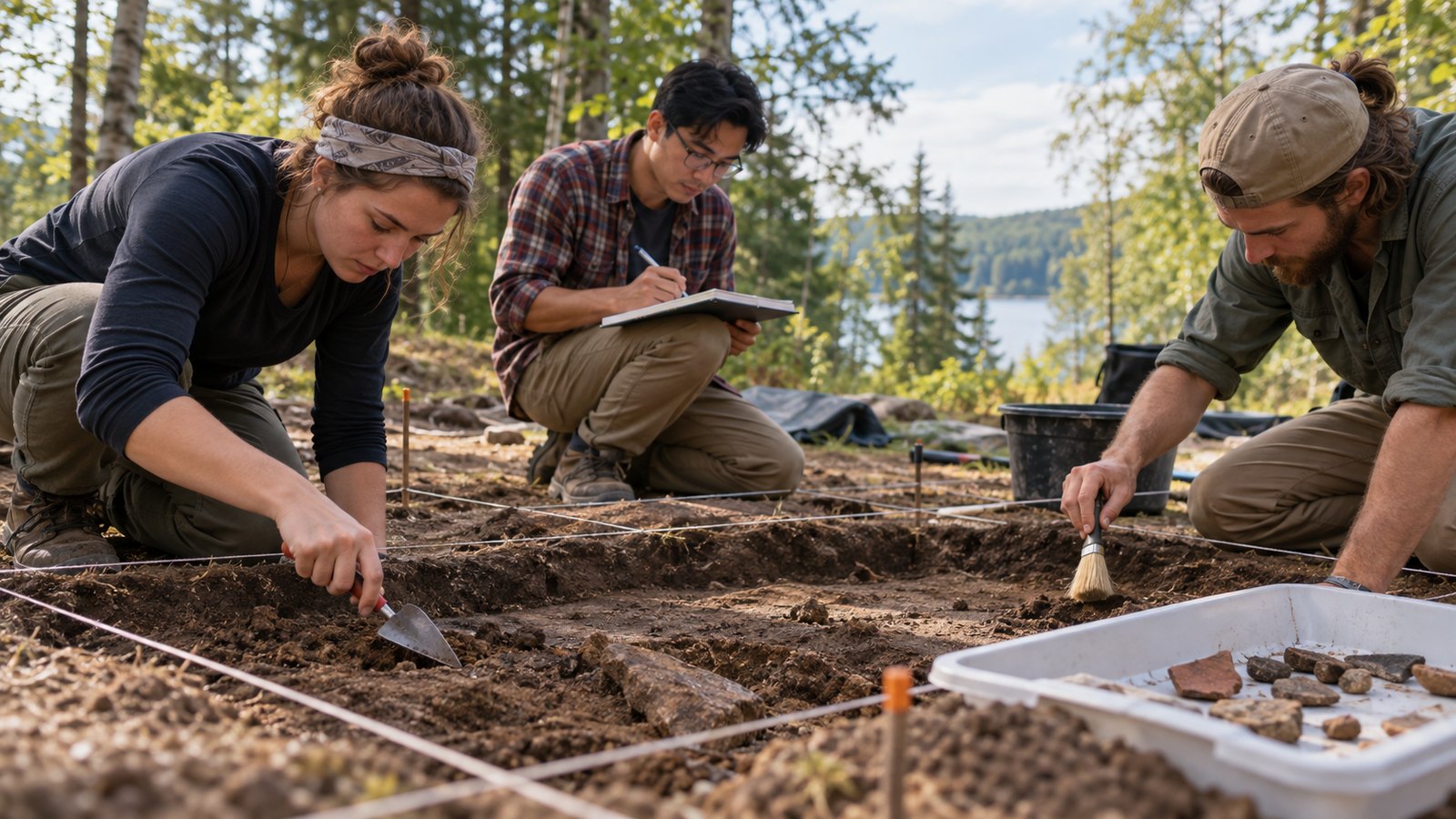
Fieldwork provides an initial point of distinction. Laval’s Baccalauréat en archéologie includes a five-week excavation placement. Its anthropology program, meanwhile, requires nine credits of practical training in the third year, which may involve research, ethnographic fieldwork or a professional setting: it is not necessarily an excavation.
| Your main interest | What to examine in the curriculum |
|---|---|
| Taking part in archaeological excavations | Practical training, conditions for access to the site and recognition of credits |
| Understanding social and cultural experiences | The role of ethnographic inquiry, interviews and qualitative analysis |
| Exploring several fields before specializing | The distribution of required courses and electives within the concentration |
| Adding archaeology to another program | The possibility of a minor and how it fits with the main degree |
This table is a decision-making aid, not a ranking. If your main interest is human evolution or biological anthropology, look explicitly for courses in these subjects: do not assume they are included based solely on the title “anthropology.”
Universities and programs
Three institutions illustrate different structures. The programs below are neither equivalent nor listed in order of preference.
| Institution and program | Confirmed structure | What this means for your choice |
|---|---|---|
| Université Laval — Baccalauréat en archéologie | B.A., 90 credits; estimated duration of three years of full-time study | A discipline-specific program with a five-week excavation placement |
| Université Laval — Baccalauréat en anthropologie | Social and cultural focus; nine credits of required practical training in the third year | A path to consider for an inquiry or research project on societies |
| The University of British Columbia — Minor in Anthropological Archaeology | Minor confirmed in the academic calendar | A component to combine with a broader program, rather than a stand-alone degree |
| McGill University — Anthropology Major Concentration (B.A.) | A 36-credit major concentration covering several fields | The 36 credits correspond to the concentration, not the complete bachelor’s degree |
Compare like structures. A minor, a major concentration and a complete bachelor’s degree do not represent the same amount of specialized study. Nor should the duration listed at Laval be applied across Canada.
For each option, identify the final degree, the other components you must complete and the requirements for entering the specialization. A program’s inclusion in a catalogue confirms that it exists, but does not prove either your eligibility or the availability of places in an upcoming intake.
In archaeology, look beyond the fieldwork destination
An excavation site may initially appeal because of its location. When choosing a program, ask instead what you will learn there and how that work will be assessed. At Laval, the five weeks of excavation are a specific component of the bachelor’s degree; they do not establish either payment or guaranteed access to a particular destination.
At UBC, the department presents ARCL 306 as a customary format for summer archaeological training worth six credits. Its field schools page describes learning activities that include surveying, mapping, recording, data management and interpretation. The experience therefore involves more than the act of excavating.
Before choosing a field school, request an information sheet specifying:
- prerequisites and the selection process;
- the activities actually planned and assessment methods;
- recognition of the credits within your degree;
- transportation, accommodation and equipment costs;
- accessibility conditions and arrangements in the event of cancellation.
UBC’s general presentation and its past examples do not constitute a confirmed schedule for 2027. Do not build your plans around a future excavation without a corresponding official announcement.
In anthropology, learn to conduct inquiries and then analyse the findings
Ethnographic fieldwork also requires preparation. At Laval, the course Techniques d’enquête et ethnographie introduces documentary research, ethnographic fieldwork and research ethics. These elements provide concrete criteria for examining a curriculum: how is an inquiry prepared, and what supervision is provided while it is carried out?
The work continues with the materials collected. Laval’s Méthodes d’analyse de données qualitatives course addresses documents, interviews, observations and visual materials, with software-assisted learning. This example shows why you should also examine analysis, not just the opportunity to undertake fieldwork.
To distinguish between two programs, ask what assignments students will produce: an inquiry report, an analysis of materials, a presentation of findings or another assessed project. Aim to describe your future experience in terms of a question and a method rather than a destination. The content of these two courses is specific to Laval; it does not automatically describe all Canadian programs.
Ethics, Indigenous communities and permits: distinct frameworks
Ethical oversight deserves a place in your comparison. Chapter 9 of the TCPS 2, 2022 edition, addresses research involving the First Nations, Inuit and Métis Peoples of Canada. Article 9.1 provides for seeking community engagement in the circumstances defined by the text, particularly when research may affect their welfare.
UBC provides a specific institutional example: the department describes training and research opportunities developed jointly with Musqueam and conducted with the approval of its Chief and Council. This partnership should not be treated as a universal procedure applicable to all fieldwork.
Ask program staff about the project’s partners, their participation in decisions and how findings are shared with them. These are training questions in their own right.
Research ethics must also be distinguished from archaeological authorization. In Quebec, excavations and interventions intended to search for archaeological objects or sites require an archaeological research permit. A student’s participation in a supervised activity is not the same as the permit holder’s responsibility. This Quebec rule should not be extrapolated to other provinces.
Career paths: distinguish a professional possibility from guaranteed access
For anthropology, Laval mentions roles in research, analysis, development, cultural mediation and project management. These are possible career paths, not a guarantee of access to each of these positions after a bachelor’s degree.
For archaeology, Job Bank indicates that a master’s degree or doctorate is usually required in the occupational group to which its profile belongs. This limitation matters: the profile falls under NOC 41409, a group broader than archaeologists alone. It therefore does not support the claim that every fieldwork job requires this level of education.
To test your plans, compare actual job postings in the province you are considering. Note the degree required, methods used, experience expected and responsibilities assigned. You can then ask the department which courses or practical assignments correspond to these requirements.
If you are considering further study, also examine preparation for research. Do not choose an undergraduate program solely on the promise of a career: check what additional steps your goal might require.
Budget: separate tuition, living costs and fieldwork
An institutional figure can serve as a reference point, provided its scope is kept clear. For 2026–2027, Laval lists CAD 28,232.96 in tuition for 30 credits in its general international undergraduate category. Its estimated total annual budget is CAD 46,863 to 51,103, with one-time expenses presented separately.
These amounts are neither a national rate nor a personal estimate. They apply to a specific international category, excluding exemptions and special categories; they must not be applied to Canadian students.
To compare your options, prepare two budgets: an ordinary academic year and a year that includes fieldwork. Ask which fees cover transportation, accommodation, meals or equipment, without assuming that they are included in tuition. Also avoid counting an expense twice if it is already included in a package.
Before accepting an offer of admission, have your fee category and the costs of practical activities confirmed. A possible source of financial aid should not be treated as secured funding.
Preparing your application and making your choice
Admission to the university and access to a specialization are two separate matters to verify. Information specific to a concentration does not replace general admission requirements. Build your comparison around your existing qualification and the conditions applicable to your application, rather than a rule assumed to be common to everyone.
For international students who require a study permit, IRCC normally requests a letter of acceptance, proof of identity and financial support, and, in most cases, a provincial or territorial attestation letter. Exceptions exist. This general information, accessed on October 24, 2026, does not constitute individual advice; the requirements specific to your situation must be examined before you apply. For Quebec, also check the requirements relating to the Certificat d’acceptation du Québec (CAQ). This process does not apply in the same way to Canadian students.
For your final decision, try completing this sentence for each program: “I am choosing this path to learn this method, within this degree structure, with this practical experience and a confirmed budget.” If any part remains unclear, send the department a specific question. A comparison based on learning, supervision and the limits of the program will be more useful than a preference based solely on its title.