

Chemistry or Chemical Engineering: Clarifying Your Goals
Are you more interested in analysing a sample, studying the properties of a substance or designing a manufacturing process? This distinction helps separate chemistry from chemical engineering. McGill describes the latter, in particular, in terms of moving from a product obtained in the laboratory to large-scale production. It is therefore not simply a chemistry education with more practical work.
To begin narrowing your choices, formulate a question that interests you: how can a contaminant in water be identified? How can chemical changes in food be studied? How can a process be scaled up? Then use it to examine the required courses and proposed projects.
Compare the structure of the degree as well, not just its title. At Sherbrooke, the bachelor's degree in chemistry comprises 90 credits; the chemistry major at UBC Okanagan is part of a degree requiring at least 120 credits. This difference does not establish that one education is more comprehensive: the studies required for entry must be taken into account. Similarly, a minor, a major and a specialized focus do not necessarily represent equivalent pathways.
Universities and Programs
These four examples offer different points of comparison. They are neither a ranking nor an exhaustive list of Canadian programs.
| Institution and program | Focus to examine | Point to note |
|---|---|---|
| Université de Sherbrooke — Baccalauréat en chimie — cheminement général | A general education, with regular and co-op streams | Read the conditions for the chosen stream and the placement schedule |
| The University of British Columbia, Okanagan campus — Chemistry | A chemistry education with opportunities for supervised undergraduate research | Distinguish information about Okanagan from information about Vancouver |
| University of Toronto — Environmental Chemistry Major (Science Program) | Contaminants, their fate and their effects in different environments | Admission to this major is limited and takes place after initial university studies |
| McGill University — Food Science - Food Chemistry Option (B.Sc.(F.Sc.)) | Chemistry applied to food | This is a food science focus, distinct from general chemistry |
At Toronto, the program presented belongs to the Faculty of Arts & Science. It examines contaminants in soil, air, water and biological tissues, among other topics: do not automatically assume that the arrangements for a program at another campus apply to it.
At McGill, the food chemistry option is presented in connection with activities such as research, quality control and product development. These fields help explain its focus; they do not constitute a promise of employment.
Laboratories: Looking at What You Will Actually Learn to Do
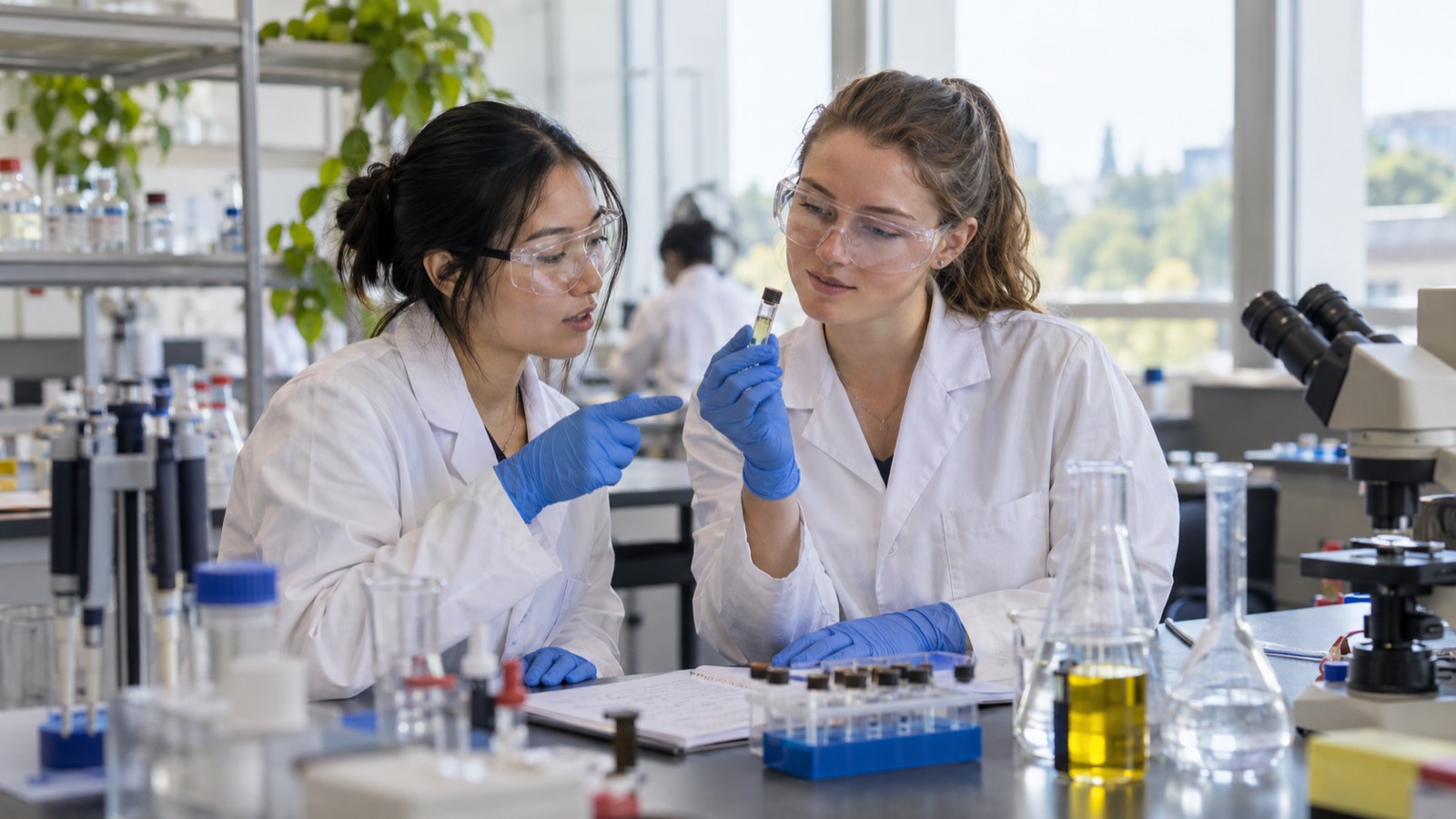
An impressive list of instruments is not enough to describe your student experience. At UBC Okanagan, the “Investigative chemistry” focus includes courses in advanced laboratory work, scientific instrumentation, chromatography and mass spectrometry. These course examples do not mean that every student will systematically use all the instruments independently.
At Toronto, the Focus in Practical Chemical Analysis addresses laboratory skills in detection, identification and measurement. It is incorporated into certain chemistry programs: it is not a stand-alone degree.
To compare two curricula, ask specific questions:
- Which practical laboratory courses are required, and which depend on electives?
- Do students prepare samples and process the results themselves?
- How are safety, traceability and data analysis assessed?
- Is there a supervised experimental project, and how can students access it?
Also ask for an example of a project or report expected at the end of the program. It will help you understand the progression from following a protocol to developing an experimental approach.
Co-op and Work Placements: Distinguishing Program Admission from Placement
The word “co-op” is not enough: you need to examine selection, the sequence of terms and the conditions for finding a work placement.
At Sherbrooke, the structure of the bachelor's degree can include four work placements. However, the regulations allow students to finish with three placements when four are not available. It would therefore be misleading to promise four placements to every admitted student. Access to the co-op stream requires full-time studies and a cumulative average of at least 2.0 out of 4.3, subject to the availability of placements.
At UBC Okanagan, access to co-op requires a separate application. The page consulted on October 26, 2026, specifies, among other requirements, third-year standing, full-time studies and a reference average of 70%. Students must also have at least 21 university credits remaining after the academic year in which they apply. The page allows for a possible holistic review of applications below the 70% threshold: it therefore serves neither as a guarantee of selection nor as an absolute exclusion.
The program requires students to plan for at least three work terms, totalling twelve months. Admitted students must then compete for jobs. Admission to co-op is not equivalent to a placement offer.
Before choosing a pathway, ask what fees apply, what geographical mobility is necessary and how the degree progresses if a placement is not secured. For budgeting purposes, do not treat income that is still hypothetical as confirmed funding.
Admission: Separating University Entry from Access to a Specific Pathway
Your comparison should include two questions: “Can I enter this university with my qualification?” and “When, and under what conditions, can I enter my chosen pathway?”
At Toronto, admission to the Environmental Chemistry Major (Science Program) takes place after initial university studies and depends, among other things, on results in the required courses. The program has limited capacity: meeting the published minimum requirements does not guarantee a place.
At McGill, the food science page describes a 30-credit foundation year for students entering university for the first time from a secondary school system outside Quebec's CEGEPs. It precedes the credits for the major and the option. This rule concerns the program presented; it should not be extended to all programs at McGill or in Canada. Requirements and any recognition of prior learning must still be confirmed based on the qualification submitted.
For each application, compile the following on a single sheet: the entry qualification, required science subjects, language requirements, supporting documents, deadlines and conditions for admission to the specialization. A catalogue entry confirms that a pathway exists, not that you are eligible.
Pathways: Course Recognition or Scientific Preparation?
Two arrangements at Sherbrooke illustrate different needs: recognizing completed technical education or preparing for entry into a science program.
The DEC-BAC pathway is intended in particular for holders of a DEC in laboratory technology — analytical chemistry laboratory or biotechnology laboratory profiles. The department presents a co-op pathway lasting two years and eight months, including three paid work placements. However, recognition depends on the specific college program and the cohort schedule. This arrangement does not mean that every foreign technical qualification automatically provides access to the same pathway.
The Baccalauréat 4 ans en sciences — Cheminement préparatoire en chimie serves a different purpose. The preparatory pathway accepts certain educational backgrounds from outside Quebec. According to the official procedure, students must first apply for admission to the intended regular bachelor's program; eligible applicants are then transferred to the preparatory pathway. Direct application to this pathway is not possible. Returning to the regular program requires successful completion of the required preparatory activities with a cumulative average of at least 2 out of 4.3.
The right question is therefore not simply “Is there a pathway?” but “What does it recognize in my educational background, and what procedure must I follow?”
Budget: Calculating the Cost of the Entire Pathway
Build your budget using official tools and the parameters that match your situation. Sherbrooke offers an estimation tool for one year of full-time undergraduate studies in the regular stream, without a work placement. It estimates tuition fees and living expenses: check which expenses are already included, then add any missing items to avoid counting housing or other expenses twice. Have co-op-specific costs calculated separately.
In particular, examine the fees associated with work terms. The UBC Okanagan page distinguishes between administrative fees and fees per work term, but the amounts displayed when it was consulted explicitly apply to 2025-2026. They must not be presented as 2026-2027 rates.
No single amount provides an honest comparison of the four institutions here. Use a personal table that distinguishes study costs, living expenses, placement costs and resources already confirmed. Keep income from placements not yet secured in a separate column.
International Students: What Rules Apply to a Required Work Placement?
The administrative conditions for international students must be distinguished from those for Canadian students. According to Immigration, Refugees and Citizenship Canada sources consulted on October 26, 2026, eligible international post-secondary students no longer need a separate co-op work permit, as of April 1, 2026, to complete placements required by their program.
This does not remove the other conditions. IRCC requires, among other things, a condition authorizing on-campus work on the study permit, full-time enrolment at a designated learning institution and a valid study permit or an extension application submitted before its expiry, subject to the applicable conditions. Confirmation from the institution regarding the mandatory placement is also required, and the placement component must respect a limit of 50% of the program's duration.
This measure is not a general authorization to take any job. Before starting a placement, consult the IRCC rules applicable to your situation and your institution's guidance. This information is general and does not constitute individual immigration advice.
Research and Professional Practice: Choosing Your Next Step
If research interests you, examine supervised projects available at the undergraduate level. At UBC Okanagan, the Chemistry Honours Program includes research work with a thesis, poster presentation and defence. Admission depends, among other things, on academic results and the required approvals. This experience is a factor to consider when choosing a program, not a guarantee of subsequent admission to graduate studies.
Also distinguish between education and the right to practise. In Quebec, the Ordre des chimistes presents chemistry as an exclusive practice profession, subject to legal exceptions. Entry to the profession includes a review of the applicant's file and registration on the Order's roll. A degree does not replace these steps, and this Quebec regulation must not be generalized to other provinces.
To finalize your selection, focus on three questions:
- What experimental skills will I acquire?
- How do students actually gain access to placements or research?
- Which admission pathway matches my current education?
The answers will give you a stronger foundation than a choice based solely on a university's reputation.