

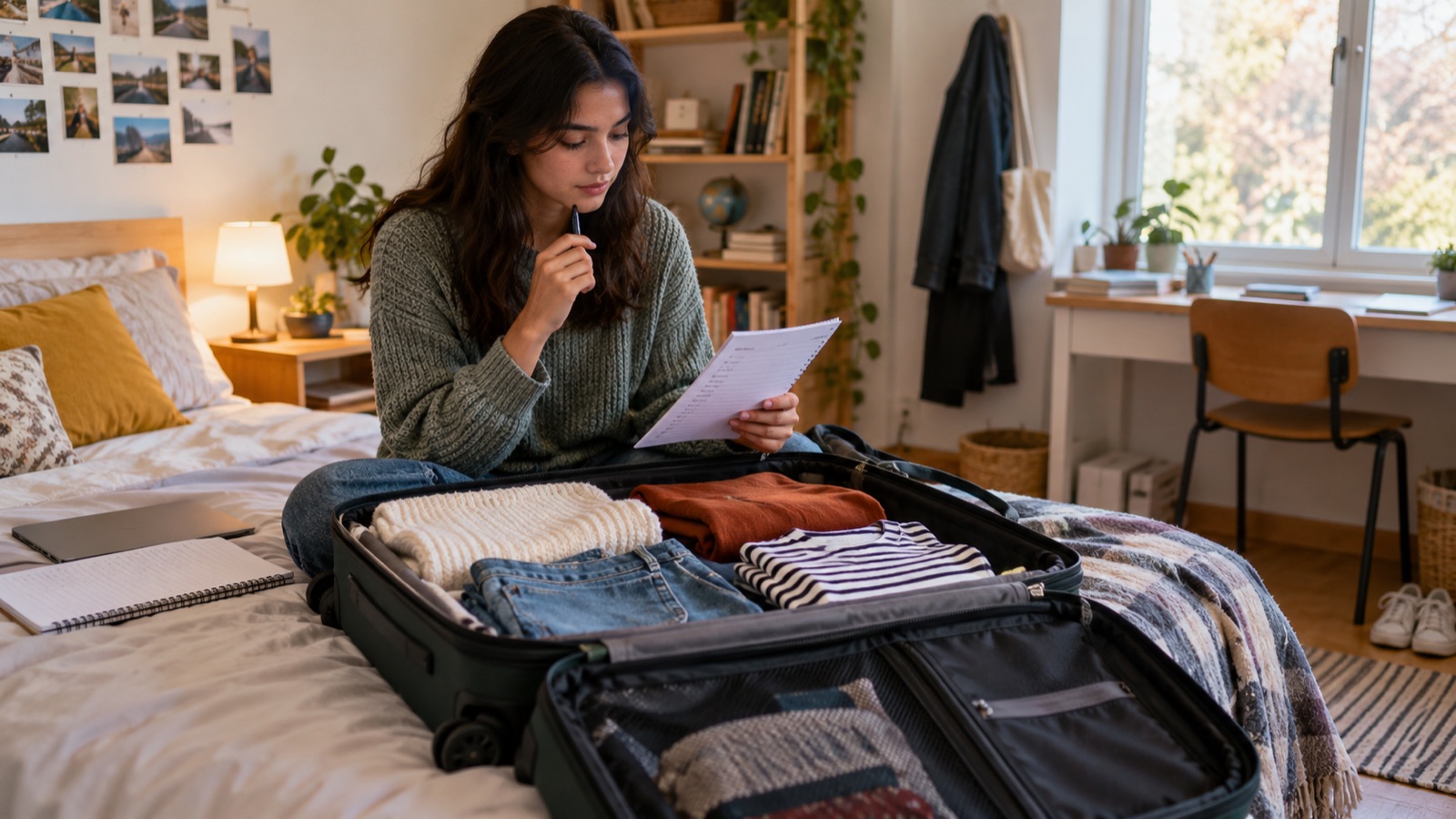
Start with your actual stay rather than suitcase size
Packing for several months does not mean taking several months' supply of everything. Start with your stay's conditions: furnished accommodation or otherwise, laundry access, arrival climate, school equipment and planned journeys. This first list distinguishes what helps from day one from what can wait.
Create three groups: essential for travel, useful during the first weeks and decisions for after settling in. Put documents, necessary treatments and arrival contacts in the first. Leave decorative purchases, large utensils and some leisure equipment in the last until you know your actual space.
Ask accommodation services about provided bedding, towels and appliances. Request details rather than simply confirming “equipped accommodation.” A residence may supply furniture while students bring other items. This avoids both important omissions and bulky duplicates.
Distribute belongings by accessibility during travel
Imagine your main suitcase arrives later than you. What would you need to reach accommodation, identify yourself and spend the first night? Arrange the bag remaining with you around this scenario, within carrier limits and security rules.
Keep travel documents, useful contacts and items needed en route accessible. Include changes of clothing and toiletries appropriate to restrictions. Consider valuables separately: hard-to-replace items should not travel simply because space remains.
CATSA's cabin liquids rule generally allows containers of 100 ml or less in a transparent resealable one-litre bag. Exceptions include certain medicines and medical needs. These instructions concern Canadian screening; also check departure and transit countries.
Keep products easy to remove for inspection. Very compact packing may seem ideal at home but prove inconvenient at screening. Consider how to open and close the bag without scattering small objects in a queue.
Handle devices and batteries separately
Inventory devices actually necessary for training and daily life. A computer, its charger and a phone may cover many needs, while consoles, printers and several heavy accessories deserve separate decisions. Check program recommendations before transporting specialised equipment.
According to Transport Canada, spare lithium batteries, including power banks, must travel in the cabin and be protected against short circuits. Remove them if cabin baggage is ultimately placed in the hold. Also consult your airline's current capacity, quantity and use restrictions.
Before departure, back up important files and ensure you can access accounts from another device. Note equipment details and photograph its condition where useful. Store cables in an identifiable pouch with what you need to use them on arrival.
Check electrical markings on every device and destination requirements. Plug-shape adapters and electrical conversion devices perform different functions. If uncertain, ask the manufacturer or a qualified professional instead of trying devices at random.
Choose clothing for your activities
Prepare compatible outfits suited to an ordinary class week. Consider laundry frequency, activities and specific program requirements. Laboratories, workshops or placements may require different equipment from general classes.
Dress for arrival weather while planning how to supplement equipment for the next season. If arriving in winter, clothing needed to leave the airport must be immediately accessible. Later needs can be refined using local climate and actual journeys.
Allow reasonable space for personal comforts: a book, small photograph or familiar accessory. Choices are not purely functional. However, consider whether each fragile or bulky object contributes enough to justify transport and storage throughout the stay.
In a fictional example, Léa leaves for a year in a residence with laundry facilities. She prioritises easily combined clothing and an initial outfit suited to arrival, then waits to understand daily life before buying some equipment. She leaves space for what she brings home at year's end.
Check health products and unusual objects
CATSA's medication guidance permits certain exceptions to usual liquids limits and requires presentation for inspection. This aviation security rule does not replace Canadian health-product import rules. Prepare both checks and keep products identifiable.
For musical instruments, sports equipment, tools or medical devices, consult the carrier's specific guidance. Check dimensions, protection, possible reservations and costs. Ordinary suitcase conditions do not always establish those for special objects.
If equipment is essential to independence or training, also arrange a solution for delays or damage. Ask the institution what can be borrowed or used temporarily. This matters more than merely adding insurance whose conditions you have not read.
Measure transport costs and effort
Weigh completely packed bags, including covers and accessories. Measure them according to every carrier's instructions and check your reservation's charges. Do not assume allowances in old confirmations or granted to friends apply to your chosen ticket.
Compare three options for bulky objects: air transport, separate shipping and local purchase or rental. Add timing, formalities, possible initial unavailability and return costs to prices. Inexpensive objects become costly if they require an extra suitcase in both directions.
Finally, practise moving with all your bags. Can you hold your phone, present a document and move suitcases without help? Permitted baggage is not necessarily easy to carry. With stairs or several connections, simplifying your load can improve the whole arrival.
Close your suitcases with a final check
Photograph baggage and keep useful references without publishing contents online. Add contact information while limiting visible personal details. Check closures, wheels and handles before the last moment.
Keep a list of items needing customs declaration and check gifts entrusted by others. Clearly separate belongings you take from parcels still expected. Last-minute additions can change applicable rules or total weight.
After arrival, unpack what first makes accommodation functional. Note actual omissions before initial purchases. Your packing list becomes a starting point for suitable settling-in rather than an obligation to immediately replace everything left at home.