

Start with use rather than appearance
An object may be attractive yet difficult to use, make or maintain. Industrial design invites examining these dimensions together. Before choosing a program, observe an everyday object: handle, lamp, container or small furniture item. Who uses it? In what environment? Which actions are simple and which require unnecessary effort? Note observable facts before deciding what to change.
This approach helps specify your interest. Perhaps you mainly enjoy building models, understanding materials, drawing shapes or exchanging with users. Training may strengthen several of these skills, but programs do not all give them equal weight. Look for a pathway that broadens your method, rather than only produces more impressive images of current ideas.
Distinguish industrial design, engineering and other practices
Disciplinary boundaries may meet in a project without making qualifications equivalent. Designing product use and form does not automatically mean being qualified to validate every technical aspect. Conversely, a technically possible solution may require work on experience, gestures and understanding. Ask the school about interdisciplinary collaborations and responsibilities assigned to students.
Emily Carr identifies industrial design among its pathways and academic progression worksheets. This source establishes an identified pathway's existence; it is neither a ranking nor a career guarantee. For each intended institution, read required courses, workshops and entry conditions. Check the qualification awarded and what will actually be taught at your level.
Also examine description terms: product, interaction, furniture, manufacturing or research. Ask for complete examples illustrating these words. A program centred on physical objects will not necessarily provide desired depth in digital interfaces, and the reverse is also true. Your comparison table needs to concern learning activities rather than similar titles.
Prepare a portfolio making trials visible
Application instructions determine the quantity and type of work to present. Respect them before seeking graphic impact. Select projects showing observations, alternatives and reasons for choices. A final prototype photograph becomes more interesting when the initial problem and changes after early trials are understood.
In a group project, identify your role precisely. If you did user research and models, say so; do not attribute another member's calculations or renderings to your contribution. Also show known project limitations. A prototype made with simple means may reveal sound thinking, provided it is not presented as a finished product or tested under every possible condition.
Take care with captions: material, scale, prototype function and examined question. A volume model does not prove an object's strength; a visual simulation does not demonstrate comfort. This distinction improves presentation and prepares discussion with people assessing the project against different criteria. Your application needs to show what you know and what remains to check.
Look at how training teaches prototyping
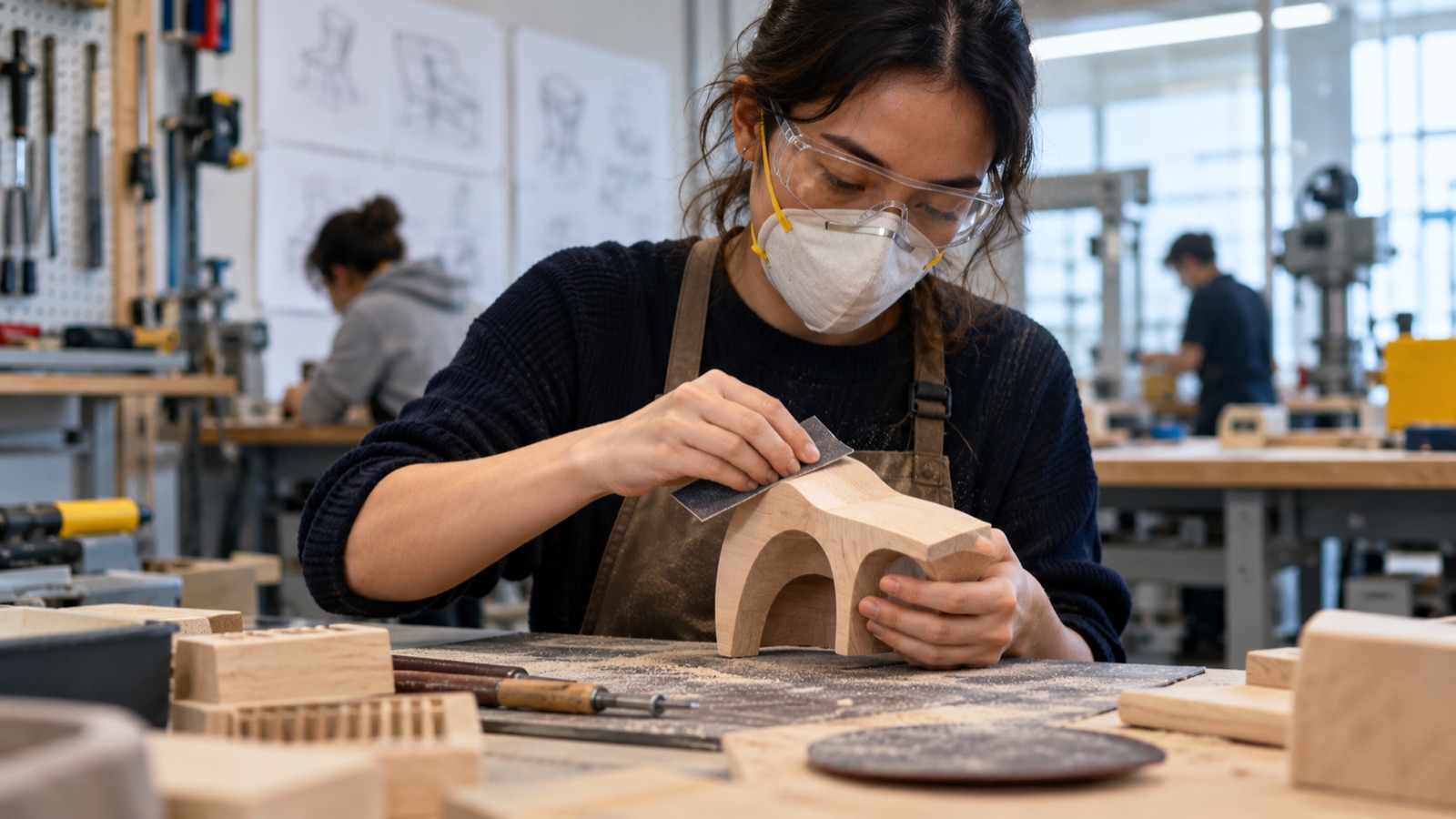
Ask which workshops are accessible, when and under what supervision. Machine access goes beyond its presence on campus. It may depend on training, booking or a production calendar. Also check permitted materials and safety procedures. You can then estimate whether the program allows several trial cycles or projects rely mainly on a final presentation.
Look for courses connecting observation, drawing, modelling and feedback from experience. A useful comparison exercise takes a student project and identifies documented decisions. Why this handle? Why this assembly method? What did testing reveal? If answers are unavailable online, ask during an information session. This helps understand teaching methods without claiming to judge an entire school from a few images.
Organise tests around a precise question
A useful trial answers a limited question. Do you want to understand whether an object is easily grasped, fits a given space or works understandably without explanation? Define this question before making the prototype. You will avoid an expensive model when simple assembly would have sufficed to observe a gesture or compare two dimensions.
Here is a fictional example: you design a container to open with one hand. You create three closure models and observe volunteers' gestures in a controlled situation. You note hesitation and errors without prompting the solution. This trial may guide design, but does not prove safety or suitability for everyone. State this limitation in your review and identify necessary additional checks.
Also consider respect for participants. Explain the objective, request agreement and avoid collecting unnecessary personal information. Do not turn a student project into risky experimentation with an unvalidated object. If an activity involves a sensitive context, ask the teacher about applicable procedures beforehand. Method quality includes how people participate in work.
Budget manufacturing and revisions
List consumables, printing, cutting, small parts, tools and transport. Ask what is included in program fees and what requires separate payment. Reserve an amount for several versions. A budget allowing only one prototype may push you to defend an initial solution when modifying it would be the educational benefit.
Computer or software cost needs comparing with actual course needs. Wait for precise recommendations before buying. Ask the school about licences, available rooms and remote work possibilities. Consider model storage in housing and on campus. Large objects may become a major constraint when moving or at term-end.
Prepare a useful presentation for the next step
At a project's end, write a short sheet: problem, intended users, constraints, tested solutions, result and limitations. Add images demonstrating these stages. This archive allows preparation of a professional portfolio or another training application. It will be easier to update than a document built solely around final renderings without process explanation.
Study career opportunities as sets of tasks: research, design, prototyping, development or coordination. Do not assume the qualification guarantees a specific position or immediate access to every responsibility. Compare progression against skills requested in interesting projects and identify useful complementary experiences. You can choose electives and collaborations with concrete direction while retaining opportunities to evolve your specialisation.
To compare proposals, choose criteria linked to the initial problem: ease of handling, space requirements, understanding and repairability, for example. Explain why each criterion matters and how you observed it. Avoid an overall score concealing an important defect. Two solutions may receive similar assessments while involving very different trade-offs. This framework then supports discussion with teachers instead of artificially declaring your idea the winner.